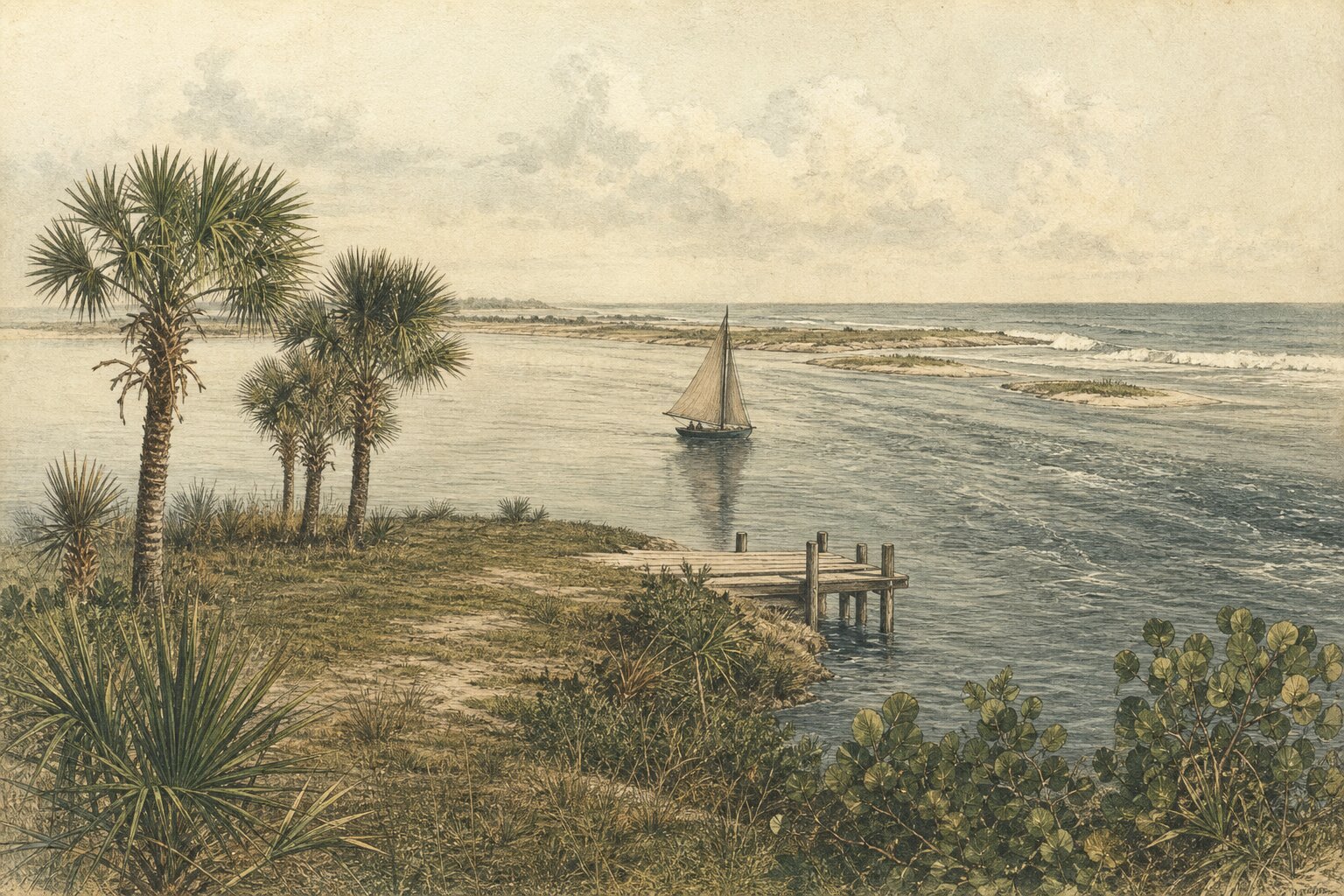
At the south end of the county the Indian River meets the St. Lucie River at Sewalls Point, and about two and a half miles beyond the point their water reaches the sea. The gap in the barrier island where it does so, the St. Lucie Inlet, was the neighborhood’s own work. Citizens of the vicinity cut it through the sand ridge in October 1892, thirty feet wide and five feet deep, and the rivers did the rest.
By the government survey of 1898 the opening had grown to seventeen hundred feet across with seven feet of water. By 1908 it was wider still, with about six and a half feet at low water and sand shoals forming at the mouth and in the river inside it. What the county wanted was a harbor, and for five years it campaigned to get one.
Two cents a crate
The first money pledged toward the inlet came from the pineapple growers. On Wednesday, February 6, 1907, at a meeting of the Indian River Pineapple Growers’ League in the Improvement Club building at Fort Pierce, a petition went round for the opening of the inlet at Sewalls Point, each grower pledging two cents on every crate he shipped that season. The argument was freight: once vessels could enter the Indian River, the growers reckoned, the railroad’s rates would come down by a fifth. Seventeen growers representing 72,000 crates signed in the first two days, and a man who grew no pineapples subscribed fifty dollars.
The state legislature asked Washington for help as well. John W. Watson, the Dade County representative, whose county then reached north to the inlet’s south shore, introduced and passed a memorial to Congress asking for an appropriation to survey and deepen the entrance, so that larger boats could come into the river up to Stuart and along the Indian River, and by the spring of 1908 he could tell the voters that a United States dredge was at work there. On January 31, 1908 the War Department ordered its engineers to make a new survey of the inlet, with a channel of not less than eighteen feet in view.
The engineers come
The district engineer’s report was dated at Jacksonville on October 1, 1908. The locality was worthy of improvement, it found, and it proposed a channel and anchorage basin eighteen feet deep at mean low water, with a jetty on the north side of the entrance against the heaviest seas, which come from the northeast, and probably a second on the south side in time.
Then the Board of Engineers for Rivers and Harbors came down to look. Fort Pierce’s Board of Trade met on the morning of Tuesday, December 8, at the office of its secretary, F. L. Hemmings, under its president, Judge A. D. Penney, to prepare statistics for the hearing, and on Friday, December 11, 1908, the board held its public hearing at the Gilbert’s Bar club house near the inlet, before a large number of interested persons with written and oral statements to make.
The board’s report, dated December 22, took the county’s case seriously. There was no harbor on the east coast of Florida for three hundred and fifty miles south of Jacksonville, and a paper had been put in citing the wrecks of recent years within a few miles of this spot, so the improvement would have value as a harbor of refuge for light and moderate-draft vessels quite apart from commerce.
The commerce itself was unusual. No town or commercial center of importance stood at the inlet, but the country up and down the Indian River shipped about 750,000 crates of pineapples and 75,000 crates of oranges a year, with vegetables and fish besides, and paid freight on all of it by rail. Set against a probable all-water rate, the board reckoned a possible saving of two to six hundred thousand dollars a year. The purpose was to let seagoing vessels of moderate draft into the harbor inside the inlet, where the light-draft boats that plied the river could load them.
It settled the plan and the price. A channel 250 feet wide and 18 feet deep across the bar would do for present needs, with the channel inside as the district engineer had drawn it; two jetties would be necessary, not one, their distance apart a matter for further study. Carried to Sewalls Point, the district engineer’s prices came to $1,310,000, a second jetty added $150,000, and with the economies the division engineer had suggested the board believed the whole improvement should not exceed $1,400,000.
That was the figure the county carried for the next three years. It went into the standing description of Fort Pierce that ran week after week in the town’s paper: eighteen miles from Santa Lucia Inlet, where the government will probably spend $1,400,000 for a harbor in the near future.
Waiting on Washington
Through 1909 the county kept its hopes up. Stand on the lawn of Captain H. E. Sewall’s home at Sewalls Point in February 1909, as a visitor from Fort Pierce did, with the calm Indian River on your left, the deep, swift St. Lucie on your right and the Atlantic breaking on the shallow bar in the distance, and the harbor seemed close: the government was expected to begin dredging the inlet the next year, giving a safe refuge in storms with anchorage in the twenty feet of water thereabouts.
In May came word that the government was sometime soon to dredge a twelve-foot channel down the Indian River from Fort Pierce sixteen miles to the St. Lucie Inlet, which would also be deepened, so that large vessels could go up the St. Lucie River to Stuart. A government harbor at the inlet, the town argued, would benefit the county and the whole East Coast.
In December Captain Sewall came up to Fort Pierce confident that the present session of Congress would appropriate the money the engineers had recommended: he held a pledge from every member of the Florida delegation, and he had entire confidence in Senator Taliaferro and Congressmen Clark and Sparkman. Congressman Frank Clark had pledged himself to secure an appropriation to open the inlet, and Fort Pierce meant to hold him to it before the primary of the coming year.
The county’s other inlets
The St. Lucie was not the only inlet the county wanted open. Fort Pierce had its own, the Indian River Inlet three miles from town, the great fishing point, and in the summer of 1909 its citizens organized to keep it open.
At a meeting at Eau Gallie at the start of July, called to plan an inlet from the ocean to the Indian River at Sebastian, R. R. Gladwin of Fort Pierce reported that his town’s inlet needed deepening, that local men had organized a stock company toward a dredge and sent the papers to Philadelphia for the members of the St. Lucie Club, and he proposed that everyone along the coast take stock in one dredge and share it.
On Monday, August 23, the Fort Pierce Dredge Company was organized in earnest, with a Philadelphian as president and Gladwin as vice-president, its main object to open and keep open the main channel of the Indian River Inlet opposite St. Lucie, and its machinery on order. The fish houses that lived by that inlet are the subject of the Annals’ page on the fishing industry of Fort Pierce.
The winter of 1910
The session Captain Sewall had counted on opened badly. On Saturday, January 15, 1910, the East Coast Fruit and Vegetable Growers’ Association met at Jensen with C. A. Robinson presiding, and the operator of a Jacksonville-to-Miami boat line, with two other Miami men, laid out what water transportation along the East Coast would mean and urged a strenuous effort to get the appropriation. Few of the county’s citizens had felt enough interest to come, and the boat man said so.
At the end of the month a telegram from Congressman Clark reached Fort Pierce: have every possible New York and Eastern influence brought by wire on the New York congressman who chaired the Rivers and Harbors Committee, act promptly, and advise me. The Board of Trade called a mass meeting of the county’s citizens for the morning of Saturday, January 29, and marked the call urgent.
The news from Washington at the end of January was not good. The House committee had been in session since early in the month, and Clark had appeared before it in an earnest appeal for an eighteen-foot development of St. Lucie Inlet, which the district engineer had favorably reported; but the committee’s disposition that session was toward economy, paring every appropriation down to the bone of absolute necessity in compliance with the administration’s program. In Fort Pierce the Tribune, no friend of the Senator, apportioned the blame in advance: Clark had done all that could be done in his department, and it was now up to Taliaferro to show he was at least trying to make good.
The final kick
By the first of April the proposition was dead for the session. After being buffeted about and disfigured in many ways, it had been given, as Fort Pierce put it, a final kick by the board of government engineers. The Rivers and Harbors Committee had sidetracked it and passed the bill without it. The Florida delegation had then taken it to the Senate Commerce Committee, whose chairman listened long enough to ask the engineers for a modified estimate on a twelve-foot channel instead of the eighteen everyone had recommended.
The supplemental report was made, and the senior member of the board gave the whole matter a black eye by pointing to an act of March 3, 1909 that provided for a survey of an inland waterway along the Florida East Coast with a twelve-foot channel, which he said would serve the same purpose. The board, he concluded, deemed it inadvisable for the United States to undertake the construction of such a channel at that time.
A Senate race on the inlet
The inlet went straight into the campaign for the United States Senate. Napoleon B. Broward, the former governor, was challenging Senator James P. Taliaferro in the Democratic primary, and on the East Coast the inlet was the question.
Late in March Judge A. D. Penney of Fort Pierce wrote to Taliaferro’s campaign manager that the Senator would be watched very closely by the people of the East Coast in the matter of the Santa Lucia Inlet, and that some were saying his advocacy of deepening it was not sincere. The manager wrote back that the Senator was bringing every power he had to bear, that he might fail, and that if he did it would not be because he had not tried; a Jacksonville lawyer wrote in the same vein, and all three letters were printed in Fort Pierce for the voters to read.
Broward came to see for himself. On Thursday, April 21, on his way to speak in Fort Pierce, he stopped at Stuart, visited the inlet, got the status of the proposition and the data for pushing it from the interested parties, and pledged himself to do all in his power toward securing the appropriation. In Fort Pierce he spoke for two hours, and among his promises was to work for the completion of the proposed inland waterway from Boston to Mexico and the opening of such inlets and harbors as were entitled to consideration.
The first primary, on May 10, was the closest Senate contest Florida had seen. Broward led Taliaferro by three votes on the unofficial returns and by sixty-nine on the official count, with a third candidate far behind, so a second primary was needed. Every East Coast county gave Broward a majority, and St. Lucie gave him a large one, 416 to 135 on the unofficial returns, with 16 for the third man.
The Tribune, which had campaigned against Taliaferro all spring, put the case for the second round in one paragraph on June 3: a vote for Broward was a vote for the prosperity of Fort Pierce and St. Lucie County, and would mean the opening of inlets for commerce and the fish industry, the opening of the canal for a steamboat line to Jacksonville, and another railroad for the section. On June 7 Broward won the nomination by more than two thousand votes statewide, though in St. Lucie County the returns showed a gain for Taliaferro.
Broward never took the seat. He died at a Jacksonville sanatorium on Saturday, October 1, 1910, where he had gone for an operation, and Fort Pierce mourned him with the rest of the state. The county’s candidate for the inlet was gone before Congress met again.
The storm and the promoters
That same October a hurricane did a little of what Congress would not. It was an ill wind that blew somebody good: by the reports that reached Fort Pierce, the storm had widened and deepened the St. Lucie inlet, making it much easier of access for boats and fish alike, to the benefit of the county’s fishing industry.
The campaign did not stop at the county line, which by then ran through the inlet: the south shore had gone to Palm Beach County when that county was made in 1909. In the spring of 1911 the Florida legislature memorialized Congress for an appropriation for the Santa Lucia Inlet and the governor signed it, and the promoters moved in behind the memorial.
The Sewalls Point Land Company was building a town on the south side, opposite the inlet and just within the north end of Palm Beach County, which it called Port St. Lucie: a hundred-foot street from the river to the railway, a canal cut from the St. Lucie River into two lakes, a dock a hundred and seventy feet long, and the argument that the port for the Palm Beaches was the Santa Lucia Inlet at Sewalls Point, on which a favorable report had been made.
Three-quarters of a mile south of it B. W. Mulford of Minneapolis was selling the St. Lucie Inlet Farms around a settlement he called Port Salerno. With the state on record, he said in Fort Pierce in June 1911, a favorable report on file at Washington and a body of influential men hard at work, a port of entry for Palm Beach County would seem to follow. The city of Port St. Lucie that exists today came half a century later and is another place; the page on its incorporation tells that story.
Through the end of 1911 the money had not come. The memorial was in Washington, the report was on file, the townsite streets were grubbed out, and the inlet was as the citizens of 1892 and the storms had left it.
The Record’s ground is the county of 1905, whose south line ran to the inlet; the county was divided again afterward, and the page on how St. Lucie County formed and was divided follows those lines. The pineapple growers whose crates began the campaign have their own page, Pineapple plantations of the Indian River, the lagoon the inlet opens is described on the page for the Indian River Lagoon, and the town whose Board of Trade carried the fight is the county seat the Fort Pierce Annals describes.
This story is drawn from the two Fort Pierce weeklies of the day, The St. Lucie County Tribune and the Fort Pierce News, digitized by the Library of Congress in Chronicling America and in the public domain.
The growers’ petition is in the Tribune of February 8, 1907; the engineers’ reports in the News of February 19 and February 26, 1909, and the Sewalls Point visit in the Tribune of February 12; the Fort Pierce Dredge Company in the News of August 27, 1909; Captain Sewall’s pledges in the Tribune of December 10, 1909; Clark’s wire and the Washington dispatch in the News of January 28 and February 4, 1910; the final kick and the Taliaferro letters in the News of April 1, 1910; Broward’s visit in the News of April 22, the primary returns in the Tribune of May 20 and the News of June 10, and his death in the Tribune of October 7, 1910; the storm in the Tribune of October 21, 1910; and the townsite and the state memorial in the Tribune of June 16 and June 23, 1911.