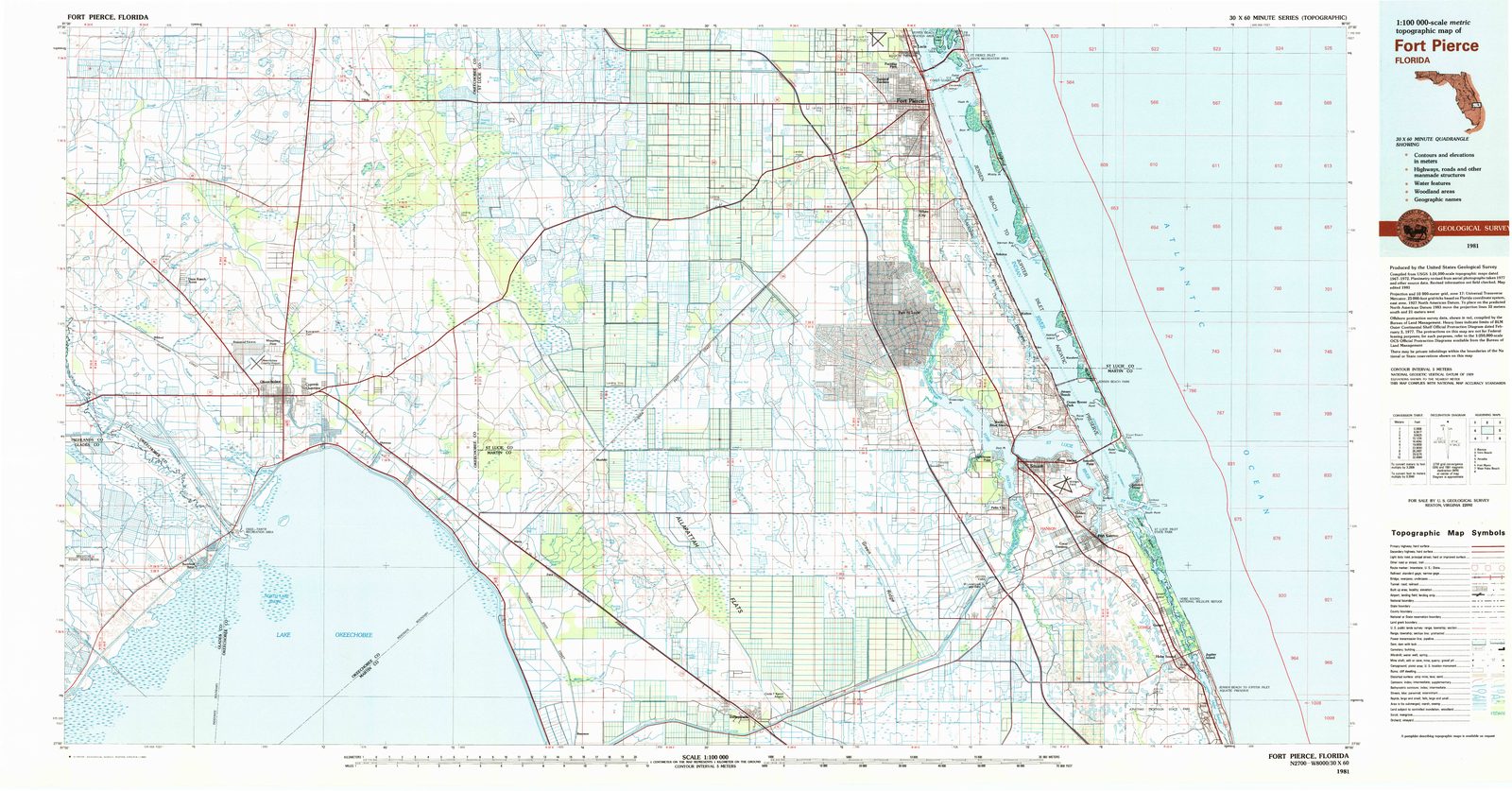
In the early 1960s, the southern portion of St. Lucie County was much as it had been for generations, a landscape of cattle ranches, pine flatwoods, and palmetto scrub stretching westward from the coast into the interior prairies. Fort Pierce, the county seat established in 1905, was the dominant community in the county, and the economy still revolved around citrus groves, cattle, and commercial fishing. The population of the entire county was modest by the standards of Florida’s rapidly growing coastal regions.
Nothing about the landscape suggested that this particular patch of scrubland would, within a few decades, become one of the largest cities in Florida. But on April 27, 1961, a new municipality was incorporated in southern St. Lucie County, and the transformation that followed would reshape the county in ways that few could have anticipated. The city was Port St. Lucie, and the force behind its creation was a Miami-based company called the General Development Corporation.
Before the city: cattle country
The land that would become Port St. Lucie was, for most of recorded history, open range. Before European contact, the area was part of the territory inhabited by the Ais people, who lived primarily along the Indian River Lagoon and relied on its abundant marine resources. After the displacement of indigenous peoples and the gradual establishment of American settlement in the nineteenth century, the interior lands of southern St. Lucie County became cattle country. Florida’s open-range cattle industry, one of the oldest in North America, had deep roots in the region, and ranchers grazed their herds across vast tracts of unfenced pine flatwoods and wet prairies.
The landscape itself was characteristic of the coastal flatwoods that dominate much of eastern Florida. Slash pine and longleaf pine grew in open stands over a ground cover of saw palmetto, wiregrass, and gallberry. The soil was sandy and poorly drained, with water standing in low areas during the summer rainy season. It was not prime agricultural land, the citrus groves that drove St. Lucie County’s economy were concentrated closer to the Indian River, where the moderating influence of the water reduced frost risk. The interior flatwoods were considered marginal for cultivation, but they supported cattle ranching and timber extraction, two activities that required more acreage than capital.
This was the landscape that the General Development Corporation surveyed in the late 1950s when it began assembling the parcels that would form its newest planned community. To the company’s founders, the empty ranch land of southern St. Lucie County represented not marginal terrain but affordable opportunity, thousands of acres that could be purchased at low cost, subdivided into residential lots, and sold to buyers across the country who dreamed of a Florida address.
The General Development Corporation
The General Development Corporation was founded in the late 1950s by three brothers, Frank, Robert, and Elliott Mackle, who were already experienced Florida developers. The Mackle brothers came from a family with deep roots in the construction industry. Their father, Frank Mackle Sr., had been a prominent builder in Miami, and the sons had grown up in the business. The General Development Corporation represented their most ambitious venture: a company that would create entire cities from raw land.
Definition: General Development Corporation
The General Development Corporation (GDC) was a large-scale Florida land development company founded in the late 1950s by the Mackle brothers, Frank, Robert, and Elliott Mackle. GDC’s business model centered on purchasing large tracts of undeveloped land in Florida, subdividing them into residential lots, and selling those lots to buyers nationwide through aggressive mail-order marketing campaigns. The company developed several planned communities in Florida, including Port Charlotte in Charlotte County, Port Malabar (now Palm Bay) in Brevard County, and Port St. Lucie in St. Lucie County. GDC was one of the largest land development companies in the state during its peak years in the 1960s and 1970s.
GDC’s business model was straightforward in concept but massive in scale. The company would acquire large tracts of undeveloped land, typically in areas where land prices were low, and subdivide them into thousands of individual residential lots. It would then market these lots to buyers across the United States, primarily in the Northeast and Midwest, through large-scale advertising and direct mail campaigns. The pitch was simple and appealing: own a piece of Florida, the Sunshine State, at an affordable price. Many of the lots were sold sight unseen, with buyers relying on GDC’s promotional materials and the general allure of Florida living to justify their purchases.
Port St. Lucie was not GDC’s first such project. The company had already developed Port Charlotte in Charlotte County on the state’s southwest coast and Port Malabar (now part of Palm Bay) in Brevard County to the north. Each project followed a similar pattern: acquire the land, plat the lots, build a basic network of roads and drainage canals, and begin selling. The infrastructure that GDC provided was minimal in the early stages, paved roads, rudimentary drainage, and the promise of future community amenities. Actual home construction often came later, as individual lot owners chose to build on their properties or as GDC constructed homes for buyers who purchased combined lot-and-home packages.
Incorporation and early years
Port St. Lucie was officially incorporated as a city on April 27, 1961. The incorporation was driven by GDC, which saw municipal status as a way to establish the community’s identity and provide a framework for local governance and services as the development grew. At the time of incorporation, the area had virtually no permanent residents in the modern sense, it was still largely undeveloped land that GDC was in the process of subdividing and platting.
The early years of Port St. Lucie were characterized by the slow, deliberate process of turning raw land into a functioning community. GDC cleared pine flatwoods, dug drainage canals to manage the area’s notoriously poor drainage, and laid out a grid of streets that eventually stretched across thousands of platted lots. The company established the basic infrastructure that a city would need: water and sewer systems, roads, and a small number of community facilities. But for years, the vast majority of the platted lots sat empty, their owners living in other states and holding the land as an investment or a future retirement destination.
The 1970 United States Census, conducted nine years after incorporation, recorded a population of approximately 330 residents in Port St. Lucie. The figure underscored how small the community still was. While GDC had sold thousands of lots, the number of people actually living in Port St. Lucie was tiny. The city existed more as a legal entity and a real estate proposition than as a functioning urban community. Fort Pierce, less than ten miles to the north, remained the population center and economic hub of St. Lucie County, as it had been since the county’s formation in 1905.
The mail-order land boom
What distinguished GDC’s approach from traditional real estate development was the scale and sophistication of its marketing operation. The company spent heavily on national advertising, placing ads in newspapers, magazines, and Sunday supplements across the country. It maintained sales offices in major northern cities, particularly in New York, New Jersey, and the industrial cities of the Midwest. The marketing materials emphasized Florida’s warm climate, its lifestyle appeal, and the affordability of GDC’s lots compared to real estate in the buyers’ home markets.
The direct-mail component of GDC’s sales operation was particularly aggressive. The company mailed promotional materials to millions of households, offering lots in Port St. Lucie and its other communities at prices that seemed low to buyers in high-cost northern markets. Many of these buyers purchased their lots without ever visiting Florida, relying entirely on GDC’s descriptions, photographs, and promises. The company offered installment payment plans that made the purchases seem even more accessible, allowing buyers to pay for their lots over several years with modest monthly payments.
This mail-order approach to land sales was not unique to GDC. It was a common practice among Florida land developers in the mid-twentieth century, echoing in some ways the speculative land sales that had fueled the Florida land boom of the 1920s. But GDC operated at a scale that dwarfed most of its competitors, and its communities, Port Charlotte, Port Malabar, and Port St. Lucie, became some of the largest planned developments in the state.
The buyers who responded to GDC’s campaigns were overwhelmingly from the Northeast and Midwest, many of them working-class and middle-class families attracted by the prospect of affordable homeownership in a warm climate. For many, the purchase of a Florida lot represented a tangible investment in their eventual retirement.
Growth and growing pains
Port St. Lucie’s growth through the 1970s was steady but unspectacular. The city’s population reached approximately 14,700 by the 1980 Census, a substantial increase from the 330 recorded a decade earlier but still modest by the standards of Florida’s booming coastal cities. The real acceleration came in the 1980s, when a combination of factors, falling interest rates, a strong national economy, continued migration from the Northeast and Midwest to the Sun Belt, and the maturation of GDC’s original infrastructure investments, triggered a sustained period of rapid growth.
By the 1990 Census, Port St. Lucie’s population had surged to approximately 55,900, nearly quadrupling in a single decade. The growth brought both opportunities and challenges. New residents required schools, roads, parks, fire stations, police services, and the full range of municipal infrastructure that a growing city demands. The city government, which had been a bare-bones operation for most of Port St. Lucie’s existence, had to scale up rapidly to meet the needs of a population that was increasing by thousands of new residents each year.
The growth also brought national attention to the city. In 1988, the New York Mets selected Port St. Lucie as the site for their spring training facility. The team constructed a stadium complex, originally known as Thomas J. White Stadium, later renamed Tradition Field and subsequently Clover Park, in the western part of the city.
The arrival of the Mets raised Port St. Lucie’s profile nationally and provided an annual influx of visitors, media coverage, and economic activity during the spring training season. For a city that had been virtually unknown outside of real estate circles, the Mets’ presence was a significant marker of Port St. Lucie’s arrival as a recognizable Florida community. The economic impact of spring training on the wider region is explored further at Treasure Coast Commerce.
Meanwhile, the General Development Corporation, the company that had created Port St. Lucie, was facing serious legal difficulties. Throughout the 1980s, GDC came under increasing scrutiny from regulators and law enforcement over its land sales practices. Critics alleged that GDC had misled buyers about the value and development potential of the lots it sold, that some lots were located in flood-prone or otherwise unbuildable areas, and that the company had failed to deliver on promises of infrastructure and community amenities. In 1990, the Florida Attorney General sued GDC, alleging fraudulent land sales practices. The same year, GDC filed for bankruptcy, bringing an end to one of the most prominent land development companies in Florida’s history.
The collapse of GDC could have been a devastating blow to Port St. Lucie, but by 1990, the city had developed enough momentum and institutional independence to continue growing without its original developer. The municipality had its own elected government, its own tax base, its own school system (administered through the St. Lucie County School District), and a growing commercial sector. Thousands of residents had built homes, established businesses, and put down roots in the community. Port St. Lucie was no longer a developer’s project. It was a real city with a life of its own.
Port St. Lucie today
The growth that began in the 1980s continued steadily through the following decades. Port St. Lucie’s population reached approximately 88,800 by the 2000 Census, then surged to roughly 164,600 by 2010. The 2020 Census recorded a population exceeding 200,000, making Port St. Lucie one of the most populous cities in Florida and one of the largest by geographic area, covering approximately 120 square miles. The city had long since surpassed Fort Pierce in population, fundamentally shifting the demographic center of gravity within St. Lucie County.
Port St. Lucie grew from empty ranch land to a city of more than 200,000 residents in six decades. The city’s rise changed St. Lucie County from a rural agricultural county, defined by citrus groves, cattle ranches, and the small-town character of Fort Pierce, into a largely suburban county whose population is concentrated in the sprawling residential neighborhoods that GDC first platted in the early 1960s. The county’s economy, once dependent on agriculture and fishing, now revolves around healthcare, retail, construction, and the service industries that support a large suburban population.
Port St. Lucie’s growth has also made it a significant presence in the broader Treasure Coast region. The city’s population is larger than that of Fort Pierce, Stuart, and Vero Beach combined, and its continued expansion has implications for transportation, water management, environmental conservation, and regional planning across multiple counties. The Indian River Lagoon, the ecological centerpiece of the Treasure Coast, faces pressures from the stormwater runoff and development patterns that accompany a metropolitan area of this scale.
The legacy of the General Development Corporation remains visible in Port St. Lucie’s physical landscape. The city’s street grid, its canal system, and the layout of its oldest neighborhoods all reflect GDC’s original subdivision plans from the early 1960s. The company’s controversial history, its aggressive marketing, its legal troubles, and its ultimate bankruptcy, is an inseparable part of Port St. Lucie’s origin story. But the city that exists today has far outgrown its developer’s vision, evolving from a mail-order real estate proposition into a functioning, diverse, and still-growing community that is now central to the identity of St. Lucie County and the Treasure Coast.
The story of Port St. Lucie is, in many ways, a characteristically Florida story, a story of ambitious developers, speculative land sales, explosive growth, and the steady conversion of wild or agricultural land into suburban residential neighborhoods. It is a story with heroes and villains, booms and busts, grand promises and hard realities.
But above all, it is a story about the power of migration, aspiration, and the enduring appeal of Florida as a destination for Americans seeking a new start in a warm and sunny place. The cattle ranches and pine flatwoods that once covered southern St. Lucie County are gone, but the city that replaced them continues to grow, to change, and to shape the future of the Treasure Coast.