Before Henry Morrison Flagler’s Florida East Coast Railway reached the Indian River settlements in the 1890s, the communities scattered along Florida’s southeast coast lived in a state of profound isolation. The nearest major city was Jacksonville, hundreds of miles to the north. The nearest reliable transportation was the Indian River itself, a long, shallow lagoon that served as the region’s only highway. Settlers who had come to grow pineapples and citrus along the Indian River could produce excellent fruit, but getting it to market before it spoiled was an uncertain and often losing proposition.
The railroad changed everything. When the steel rails of the Florida East Coast Railway reached Fort Pierce around 1894, they did not merely connect one small town to the rest of Florida, they created the economic conditions that would transform a string of frontier outposts into a thriving agricultural region, attract hundreds of new settlers, and generate the population growth that led directly to the formation of St. Lucie County in 1905. No single force did more to shape the modern history of the Treasure Coast than the Florida East Coast Railway.
Henry Flagler’s vision
Henry Morrison Flagler became one of the richest men in America through his partnership with John D. Rockefeller. Flagler was a co-founder of Standard Oil, the petroleum monopoly that dominated the American oil industry in the late nineteenth century. His role at Standard Oil was primarily organizational and financial, he handled the business side of the enterprise while Rockefeller focused on operations and strategy. By the early 1880s, Flagler had accumulated an enormous fortune and was looking for new ventures.
Florida captured his attention in 1878, when he first visited Jacksonville with his ailing wife, Mary. The warm climate seemed beneficial for her health, and Flagler was struck by both the natural beauty of the state and its lack of modern infrastructure. He returned to Florida in the mid-1880s, this time visiting St. Augustine, the ancient Spanish colonial city on the northeast coast. Flagler saw in St. Augustine an opportunity: the city had history, beauty, and a mild winter climate, but it lacked the kind of luxury accommodations that would attract wealthy northern tourists. He determined to build a grand hotel and, recognizing that guests would need a way to get there, a railroad to bring them.
Flagler’s first hotel, the Ponce de León, opened in St. Augustine in 1888. It was an immediate success, drawing the northern social elite to Florida for the winter season. But Flagler was already looking south. He understood that the farther south one traveled, the warmer and more tropical the landscape became, and he began acquiring and consolidating small, disconnected railroad lines along the east coast, merging them into a single system that he would extend progressively southward.
By 1892, this system had been formally organized as the Florida East Coast Railway. Flagler’s strategy was integrated: luxury hotels would create demand for the railroad, and the railroad would deliver customers to the hotels. Together, the railroad and hotel system would open Florida to tourism, agriculture, and settlement on a scale the state had never seen.
Before the railroad: life on the Indian River
To appreciate the impact of the Florida East Coast Railway on the region that would become St. Lucie County, one must understand what life was like before the railroad arrived. In the 1870s and 1880s, the Indian River Lagoon was the lifeline of the scattered settlements along Florida’s southeast coast. This narrow, shallow body of water, running roughly parallel to the Atlantic coast for some 156 miles, served as the primary route for travel, commerce, and communication. Small sailboats, sloops, and shallow-draft steamers carried passengers, mail, and cargo between communities that were otherwise accessible only by rough trails through the pine flatwoods and palmetto scrub.
The Indian River was an adequate highway for a small, self-sufficient population, but it was poorly suited to commercial agriculture on any significant scale. Perishable goods like pineapples and citrus fruit had to be loaded onto boats, carried north along the lagoon to a point where they could be transferred to a larger vessel or a rail connection, and then shipped onward to Jacksonville or beyond.
The journey was slow, often taking days, and at the mercy of winds, tides, and weather. By the time fruit from the Indian River region reached northern markets, much of it had deteriorated in quality or spoiled entirely. This transportation bottleneck placed a natural ceiling on the growth of the agricultural economy and, by extension, on the population of the region.
The settlements themselves were small and widely scattered. Fort Pierce, which would eventually become the county seat of St. Lucie County, was a tiny community of a few dozen families in the early 1890s. Other settlements, Eden, Jensen, Ankona, Walton, White City, were even smaller. Most residents were engaged in subsistence farming, fishing, or small-scale cultivation of pineapples and citrus. Life was hard, supplies were scarce, and the nearest doctor, lawyer, or well-stocked general store might be a day’s journey by boat.
Florida East Coast Railway
The Florida East Coast Railway (FEC) is a railroad originally built by Henry Morrison Flagler in the 1890s to connect Jacksonville with communities along Florida’s Atlantic coast. Flagler, a co-founder of Standard Oil, consolidated several smaller rail lines into a single system and extended it progressively southward, reaching Daytona in 1889, West Palm Beach in 1894, Miami in 1896, and eventually Key West in 1912. The railroad was instrumental in opening Florida’s east coast to settlement, tourism, and commercial agriculture, particularly the citrus industry. The FEC Railway continues to operate today as a freight railroad, running along essentially the same coastal corridor Flagler built more than a century ago.
The railroad arrives
The Florida East Coast Railway extended southward in stages during the early 1890s. Flagler’s construction crews pushed the line through dense subtropical vegetation, bridging rivers and creeks, grading sandy soil, and laying track at a pace contemporaries found remarkable. The railroad reached Daytona by 1889, continued south through New Smyrna and Titusville, and then drove into the Indian River country that had been so long isolated from the rest of the state.
The railroad reached the Fort Pierce area around 1894. Almost overnight, communities that had been days away from the nearest city were now connected to Jacksonville, and through Jacksonville to the entire national rail network. A crate of oranges or pineapples loaded onto a railcar at Fort Pierce could be in New York or Philadelphia within days, a journey that had previously been measured in weeks when it was possible at all.
The railroad did not merely pass through the Indian River communities, it stopped in them. Flagler established stations at Fort Pierce, Jensen, Stuart, and other points along the line, creating hubs of activity where goods could be loaded and passengers could embark. The stations became the nuclei around which commercial districts formed. Packing houses, warehouses, and general stores clustered near the railroad depots, and the towns began to shift their orientation from the river to the rails. The Indian River had been the highway of the old frontier; the Florida East Coast Railway became the artery of the new commercial economy.
Flagler continued pushing the railroad south, reaching West Palm Beach in 1894 and Miami in 1896. Each extension brought new territory into the sphere of the railroad’s influence, but for the communities of the Indian River, including Fort Pierce, the critical moment was the arrival of the line itself. From that point forward, the economic trajectory of the region changed fundamentally.
Citrus, commerce, and growth
The most immediate and profound impact of the Florida East Coast Railway on the Indian River region was on the citrus industry. Citrus had been grown along the Indian River since at least the 1870s, and the region’s fruit had already earned a reputation for exceptional quality. The warm climate, the moderating influence of the Indian River Lagoon, and the well-drained sandy soils produced oranges and grapefruit with a sweetness and juice content that rivaled fruit from any other region. But without reliable, fast transportation to northern markets, the commercial potential of Indian River citrus had been severely limited.
The railroad removed that limitation. Growers could now harvest their fruit and ship it north by rail within days, arriving fresh in the markets of New York, Boston, Philadelphia, and other major cities. The speed of rail transport dramatically reduced spoilage, allowed growers to time their harvests for peak ripeness rather than for the uncertain schedule of river boats, and enabled them to command premium prices for high-quality fresh fruit. The result was an explosion in citrus planting and production throughout the Indian River corridor. For a more detailed account of the citrus industry’s development in Fort Pierce, see Indian River Citrus & the Fort Pierce Groves at The Fort Pierce Annals.
The pineapple industry also benefited from the railroad, though it took its two heaviest blows just as the FEC arrived: the Wilson-Gorman Tariff of 1894, which reduced import duties and let cheaper Cuban pineapples into the American market, and the Great Freeze of 1894–1895, which devastated the plantations. What followed was a rebuilding along the new line.
Growers who had relied on slow water transportation to move their perishable fruit now shipped by rail in carload lots, and the industry grew through the following decade to its record season in 1909, when the growers themselves counted a statewide crop of over a million crates. The railroad carried the pineapple era at its height, and later carried the citrus industry that in time took its place.
Beyond agriculture, the railroad brought settlers, tourists, and supplies to the Indian River communities in volumes that would have been unimaginable a decade earlier. New arrivals from northern states came south by rail, attracted by reports of fertile land, a mild climate, and economic opportunity. They established homesteads, opened businesses, built churches and schools, and swelled the population of the Indian River settlements. The railroad also made it practical to import building materials, machinery, household goods, and other supplies that had been difficult or impossible to obtain when the river was the only transportation link. The effect was cumulative and self-reinforcing: the railroad brought people, people created demand for goods and services, and demand attracted more people and more investment.
This population growth had direct political consequences. By the early 1900s, the settlements of the southern Indian River had grown large enough and economically productive enough to justify the creation of a separate county. The formation of St. Lucie County in 1905, carved from the southern portion of the vast Brevard County, with Fort Pierce as the county seat, was a direct result of the growth that the Florida East Coast Railway had made possible. Without the railroad, the region would have remained a sparsely populated frontier, and the political case for a new county would not have existed.
From Fort Pierce to Key West
Flagler did not stop at Miami. His most ambitious project was the extension of the Florida East Coast Railway across the Florida Keys to Key West, an undertaking known as the Overseas Railroad. It required bridges, viaducts, and causeways across more than a hundred miles of open water and low-lying coral islands, one of the most audacious engineering projects of the early twentieth century.
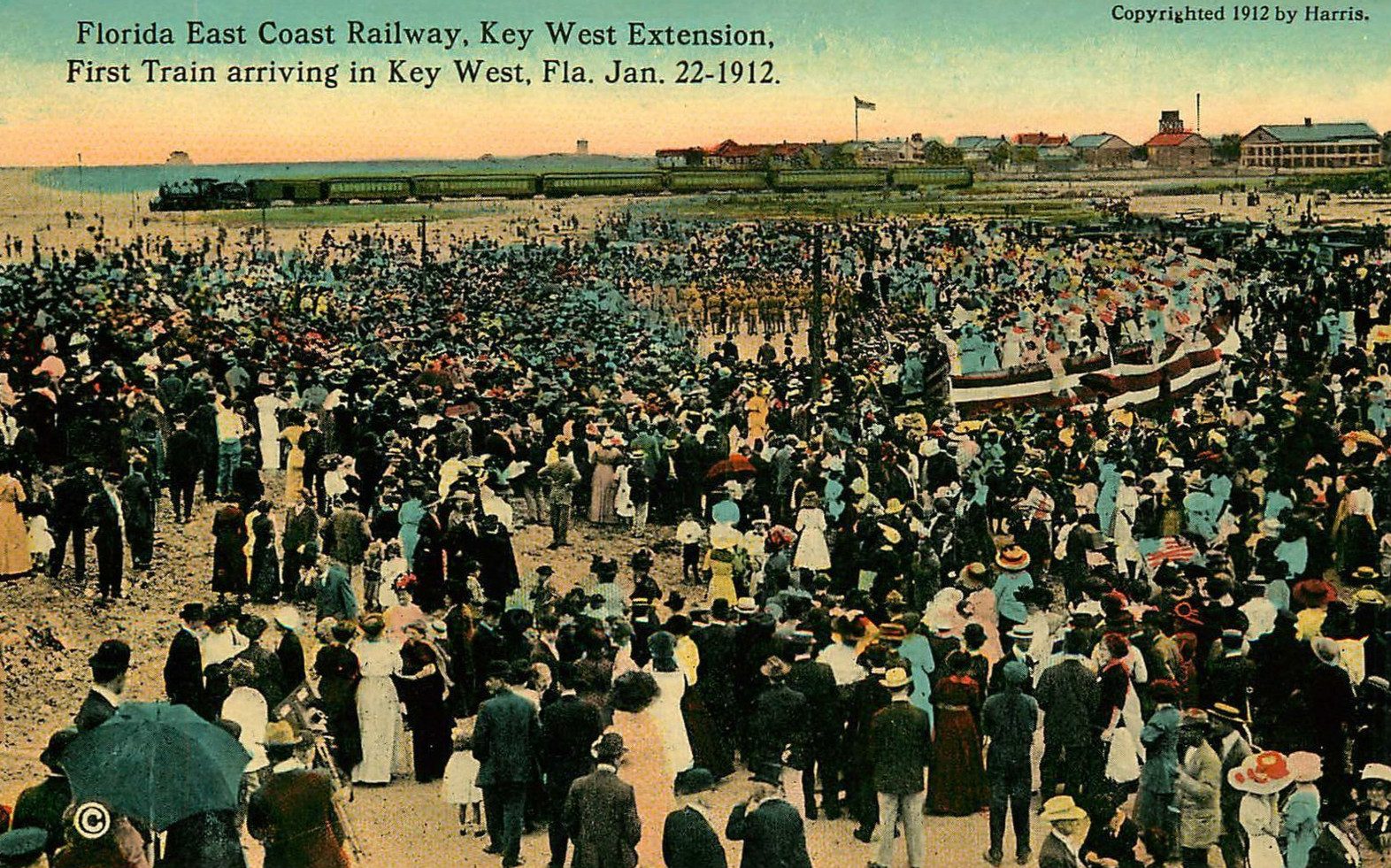
Construction began in 1905 and was completed in January 1912, when the first train arrived in Key West with the eighty-two-year-old Flagler aboard. The project cost millions of dollars and claimed the lives of workers who perished in hurricanes, accidents, and tropical diseases during the seven years of construction. Flagler himself died in May 1913, just over a year after seeing his vision completed.
The Overseas Railroad operated until 1935, when the Labor Day Hurricane destroyed large sections of the Key West Extension. The railroad was never rebuilt. Instead, the surviving bridges and roadbed were converted into the Overseas Highway, which remains the primary road link between the Florida mainland and Key West today.
The railway’s legacy
The Florida East Coast Railway went through significant changes in the decades after Flagler’s death. The railroad remained a vital transportation link for Florida’s east coast communities through the first half of the twentieth century, carrying both passengers and freight. But the rise of the automobile and the expansion of the highway system gradually eroded the railroad’s dominance. Passenger service, which had been central to Flagler’s original vision of luxury tourism, declined as travelers increasingly chose to drive.
A major turning point came in 1963, when the FEC Railway experienced a bitter and protracted labor strike. The strike, which began in January 1963, involved the railroad’s non-operating unions and was marked by violence, including acts of sabotage against railroad property. The FEC Railway continued to operate freight service during the strike using supervisory and replacement personnel, but passenger service was permanently discontinued. The strike dragged on for years and fundamentally changed the character of the railroad’s operations. The FEC emerged from the dispute as a leaner, freight-only operation.
The railroad passed through various ownership changes in subsequent decades, controlled at different times by the estate of Flagler’s heirs, the St. Joe Paper Company, and other corporate owners. Through all of these transitions, the FEC Railway continued to operate as a freight railroad along essentially the same coastal corridor that Flagler had built. Today, the Florida East Coast Railway, now known as FEC Railway, remains an active freight line running between Jacksonville and Miami, carrying intermodal containers, automobiles, and building materials along the route that once carried Flagler’s luxury passenger trains.
The Florida East Coast Railway’s legacy in St. Lucie County is inseparable from the county’s own identity. The railroad made the citrus industry commercially viable. It brought the settlers whose growing numbers justified the creation of a new county in 1905. It established Fort Pierce as a transportation hub and commercial center, cementing the town’s role as county seat. It connected the isolated communities of the Indian River to the national economy. And it set in motion the patterns of growth and development that would continue to shape the Treasure Coast for the next century. For more on the broader history of Fort Pierce and its development as the county seat, see The Fort Pierce Annals.
In many ways, the story of the Florida East Coast Railway is the story of modern St. Lucie County, isolation overcome, an economy transformed, and a region reshaped by a single piece of infrastructure.