On Saturday, August 18, 1906, the saloons of St. Lucie County closed their doors. The county was a year old. Four days earlier its voters had gone to the polls in a wet or dry election, to decide whether liquor, wine or beer could be sold inside its lines, and they had decided, by 313 votes to 182, that it could not. The St. Lucie County Tribune, which had campaigned for that answer from its front page all summer, reported the whole affair week by week.
A petition from Sebastian
Under Florida law a county could vote itself wet or dry if enough of its voters asked for an election. The petition for St. Lucie County was drawn up in the fall of 1905, a few months after the county was carved out of Brevard, by a Titusville judge acting for the temperance people of Sebastian, and the work of gathering names went on through the winter and spring. By July 1906 it carried the signatures of thirty-five percent of the county’s registered voters.
At their regular meeting in the first week of July the county commissioners received the petition and called the wet or dry election for Tuesday, August 14. The Tribune said a sentiment in favor of the step had been growing ever since the county was formed, and printed the official call in the same issue. The commissioners had ballot boxes prepared under the state law and delivered to the sheriff for distribution.
The campaign on the front page
The Tribune did not pretend to be neutral. Through July it filled its front page with what dry counties elsewhere in Florida reported: a Live Oak paper’s case that dry towns prospered, with the note that of Florida’s forty-six counties only nineteen still allowed the sale of liquor, and a report from Jefferson County on the increase in business since its saloons closed.
In August it turned to the other side’s arguments. The saloon side’s strong argument, as the paper set it out on August 10, was that prohibition did not prohibit: liquor licenses were still being taken out in the names of residents of dry counties, and they would be produced as evidence of it in every election contest in the state. The Tribune’s answer was that a large number of those licenses were issued in fictitious names, even in the names of dead drunkards, for exactly that purpose.
The other argument was the blind tiger, the period’s name for the man who sold liquor without a license and would, the saloon men said, sell more of it once the licensed houses closed. The paper declared that argument knocked out with a letter from Judge Minor S. Jones, who presided over the county’s circuit court, that the blind tiger thrives only where public sentiment is indifferent.
On Monday, August 13, the day before the vote, the paper put out an extra. Its masthead urged readers to vote as they prayed, against selling. Its columns accused the Fort Pierce News, the town’s other weekly, of going over to the saloon side at the last minute and publishing untruths to deceive the voters, and passed along, without vouching for it, the talk on the streets that the News had been bought. What the News said in reply does not survive.
Election day in Fort Pierce
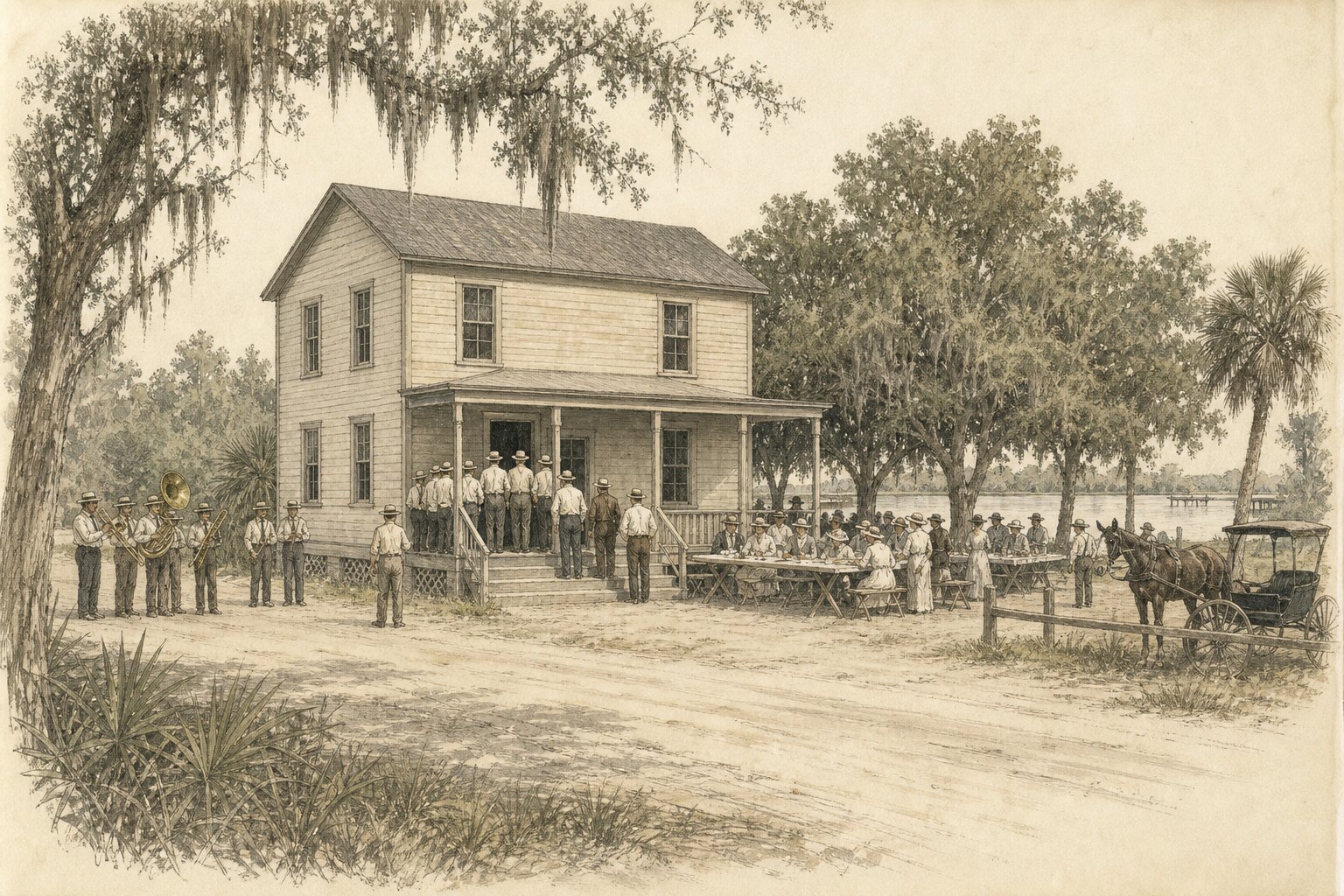
The Fort Pierce polling place was the Improvement Club’s hall, the same building the county had been renting as its courtroom since February, and the women of the town were there early. About thirty of them set out a free dinner for the voters in the rear of the building, and when the tables were ready they took charge of the ground in front of it, near the entrance to the polls.
Two hundred dinners were served. The Tribune said it was a good dinner and that it had never seen quicker service, and it reported that even the wet workers admitted the ladies and their dinner had cost them votes, though they disapproved strongly of the ladies being there at all. It took nerve, the paper said, for a voter to pass through that crowd.
The polls closed and the count began. Both sides claimed the victory, and the saloon men were jubilant. A crowd, nearly half of them women, gathered in front of the hall to hear the Fort Pierce figures, and while they waited a telegram came down from Sebastian with good news from the north end of the county. When the result was known, people came in from every part of town until the streets were full, women and children with the men, cheering, and the band, which the paper credited with faithful work, played again. The election, the paper noted, passed off quietly in Fort Pierce and no trouble occurred at any time.
On the Friday the women of Fort Pierce held a jubilee meeting at the Improvement Club hall, with the band, to celebrate the victory won at the polls on Tuesday.
The returns
The Tribune had its own representatives at every poll, and printed their figures that Friday under a one-word headline: landslide. Sebastian, where the petition had started, was the banner precinct of the county at about eighty-five percent dry. Quay, Wabasso, White City, Ankona and Viking followed with dry majorities of their own, Vero divided evenly, and with three precincts still to hear from not one had given the wet side a majority. The precincts ran the length of the county as it then was, from Sebastian in the north through Fort Pierce and Ankona to Jensen, and west to Fort Drum.
The official canvass came the next week. The county commissioners found 182 votes cast for selling and 313 against, a majority of 131 against the sale of intoxicating liquors, wines or beer in the county of St. Lucie, and directed the sheriff to inform the keepers of every saloon in the county. The saloons were closed on Saturday, August 18, after the vote was canvassed. The paper noted with satisfaction that the official count had not changed a single figure in the returns it had printed a week before.
What it meant
A county one year old had taken a large public question to the polls and settled it, and the settling had been done as much by the women at the club building as by the men inside it. The question returned in the fall of 1910 in a larger form, with the Tribune pressing the county’s dry voters of 1906 to support prohibition beyond the county line. But in August 1906 the answer was not close, and it was the same in every precinct that had reported.
The county that voted that day was far larger than the St. Lucie County of today. Sebastian, its banner precinct, and Jensen, its southern one, lie in other counties now; the page on how St. Lucie County formed and was divided follows those lines. The Improvement Club hall, the courtroom and polling place of 1906, stood in the downtown that the Fort Pierce Annals describes, and Paul Kroegel’s Sebastian is the north end of the county this vote belonged to.
This story is drawn from The St. Lucie County Tribune, digitized by the Library of Congress in Chronicling America and in the public domain: the issues of July 13 (the petition and the call), August 10 (the saloon argument answered), August 13 (the extra), August 17 (election day and the returns) and August 24, 1906 (the canvass).