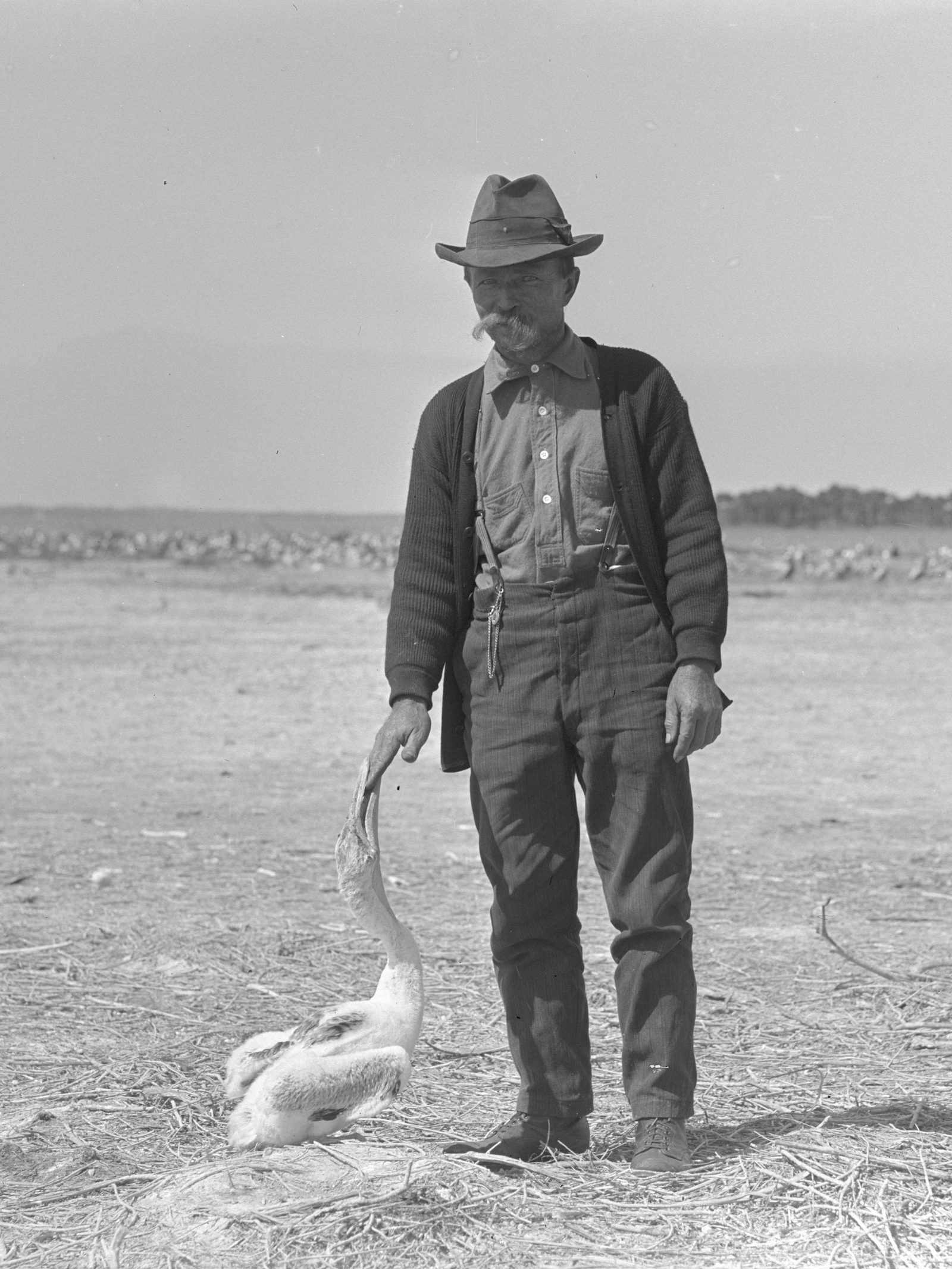
Few figures in the history of St. Lucie County embody the spirit of the settlement era as fully as Paul Kroegel. Born in Chemnitz, Germany, on January 9, 1864, Kroegel immigrated to the United States as a young man and eventually made his way to the remote shores of the Indian River Lagoon in Florida, where he homesteaded on the west bank of the Indian River near the small settlement of Sebastian.
From that modest homestead, Kroegel would go on to play two roles in the history of the region: he became the first warden of the first National Wildlife Refuge in the United States, and he served as one of the five original county commissioners when St. Lucie County was carved from Brevard County in 1905. His life is a story of quiet determination and civic responsibility, a man who fought to protect the natural world around him while simultaneously helping to build the institutions of local government that would serve his community for generations to come.
A German immigrant on the Indian River
Paul Kroegel arrived in Florida during a period of rapid settlement along the Indian River Lagoon. In the 1870s and 1880s, homesteaders were claiming land along the narrow strip of habitable coast between the Atlantic Ocean and the vast interior wetlands of the Florida peninsula. The Homestead Act drew settlers from across the country and from abroad, offering free land to those willing to improve it. Kroegel was among those who saw opportunity in this subtropical frontier, and he established his homestead on the west bank of the Indian River near Sebastian, a small community on the northern reaches of what was then the southern portion of Brevard County.
Life on the Indian River in the late nineteenth century was both challenging and rewarding. The lagoon itself, a long, narrow estuary stretching more than 150 miles along Florida’s east coast, was the lifeblood of the region. It provided food, transportation, and a moderating influence on the subtropical climate. Settlers like Kroegel fished its waters, hunted its shores, and relied on it as a highway connecting the scattered communities along the coast.
The lagoon was also home to a great abundance of wildlife. Brown pelicans, herons, egrets, roseate spoonbills, and dozens of other bird species nested on the small mangrove islands dotting the lagoon’s shallow waters. For Kroegel, the birds of the Indian River Lagoon, particularly the brown pelicans that roosted in dense colonies on a small island visible from his homestead, became a lifelong fascination and, eventually, a calling.
That small island was Pelican Island, a five-acre mangrove island in the Indian River Lagoon near Sebastian. For as long as anyone could remember, Pelican Island had served as a rookery for brown pelicans and other waterbirds. The pelicans nested there by the thousands, raising their young on a tiny patch of land surrounded by the warm, fish-rich waters of the lagoon. Kroegel, watching the island from his homestead across the river, became increasingly alarmed by what he saw happening to its inhabitants.
The plume trade and the fight for Pelican Island
In the late nineteenth century, the fashionable women of America and Europe adorned their hats with the feathers, wings, and sometimes entire bodies of wild birds. The millinery trade, the hat-making industry, created an enormous demand for bird plumage, and commercial hunters known as plume hunters ranged across the wetlands, coastlines, and lagoons of Florida to supply it. Egrets were particularly prized for their delicate breeding plumes, which could fetch high prices by weight, at times exceeding the price of gold. But plume hunters were not selective; they killed herons, spoonbills, terns, pelicans, and virtually any bird whose feathers or parts could be sold.
The slaughter was devastating. Entire rookeries were wiped out as hunters descended on nesting colonies during the breeding season, when birds were concentrated in large numbers and reluctant to abandon their nests and young. The killing of adult birds during nesting season often meant the death of their chicks as well, compounding the destruction. Across Florida, bird populations that had once numbered in the millions were collapsing under the pressure of the plume trade.
Definition: National Wildlife Refuge
A National Wildlife Refuge is a designation for protected areas of land or water managed by the U.S. Fish and Wildlife Service within the National Wildlife Refuge System. The purpose of a wildlife refuge is to conserve fish, wildlife, and plants and their habitats. The first National Wildlife Refuge was Pelican Island, designated by President Theodore Roosevelt on March 14, 1903. Today, the National Wildlife Refuge System encompasses more than 560 refuges and 38 wetland management districts across the United States, protecting approximately 150 million acres of habitat.
Pelican Island was not spared. Plume hunters visited the island and killed nesting birds for their feathers and skins. Paul Kroegel, who had watched the pelican colony from his homestead and had come to regard the birds as neighbors deserving of protection, took it upon himself to defend them. Even before any legal authority existed to protect the island or its inhabitants, Kroegel began patrolling the waters around Pelican Island, confronting hunters and driving them away. He was a private citizen acting on personal conviction, armed with little more than a boat and a determination that the killing should stop.
Kroegel’s efforts drew the attention of prominent conservationists and ornithologists who were working to build a national movement against the plume trade. The Florida Audubon Society, founded in 1900, and the American Ornithologists’ Union were among the organizations lobbying for the legal protection of nesting bird colonies. They saw in Pelican Island a powerful symbol, a specific, identifiable place where a specific community of birds could be saved if the federal government would act. And they saw in Kroegel a man already doing the work that a government-appointed protector would need to do.
America’s first National Wildlife Refuge
On March 14, 1903, President Theodore Roosevelt signed an executive order designating Pelican Island as a federal bird reservation, the first National Wildlife Refuge in the United States. The designation was a landmark moment in the history of American conservation. For the first time, the federal government had set aside a piece of land specifically for the protection of wildlife. The action established the precedent for what would become the vast National Wildlife Refuge System, which today encompasses more than 560 refuges across the country.
On April 1, 1903, Paul Kroegel was appointed as the first warden of the Pelican Island bird reservation, making him the first federal wildlife officer in the history of the National Wildlife Refuge System. His salary was one dollar per month, a sum that reflected both the modest resources of the early conservation effort and the understanding that Kroegel’s motivation was not financial. He had been protecting Pelican Island on his own initiative for years; the federal appointment simply gave him the legal authority to continue doing so.
As warden, Kroegel patrolled the waters around Pelican Island in his small boat, watching for plume hunters and warning them away. The work was sometimes dangerous. Plume hunting was a lucrative business, and the men who pursued it were not always willing to accept the authority of a lone warden backed by a distant federal government. But Kroegel was persistent. He continued his patrols for years, guarding the nesting birds through breeding season after breeding season and ensuring that Pelican Island remained a safe haven for the brown pelicans and other species that depended on it.
The success of the Pelican Island reservation inspired President Roosevelt to create additional wildlife refuges across the country. By the end of his presidency in 1909, Roosevelt had established fifty-one federal bird reservations. The movement that began with Kroegel’s quiet patrols around a small mangrove island in the Indian River Lagoon had grown into a national conservation policy that would protect millions of acres of habitat for generations of wildlife. The Pelican Island National Wildlife Refuge endures today as both a functioning wildlife sanctuary and a historical landmark commemorating the birth of the refuge system.
Founding commissioner of St. Lucie County
While Paul Kroegel was building his legacy as a conservation pioneer, he was also participating in the civic life of his community. In 1905, just two years after his appointment as warden of Pelican Island, Kroegel took on a second historic role: he became one of the five original county commissioners of the newly created St. Lucie County.
On May 24, 1905, the Florida Legislature passed the act creating St. Lucie County from the southern portion of Brevard County. Governor Napoleon B. Broward signed the legislation, which designated Fort Pierce as the county seat and took effect on July 1, 1905. The governor’s appointments reached the St. Lucie County Tribune in its first weeks of publication: Paul Kroegel of Sebastian, to be county commissioner for the first district.
By August the paper had the full board in session at Fort Pierce, one commissioner for each of the new county’s five districts: Kroegel, with K. B. Raulerson of Fort Pierce, J. F. Bell of White City, W. R. Hardee of Jensen, and R. D. Holmes of Fort Drum, five home towns running the length and breadth of the county.
Sebastian, where Kroegel lived and homesteaded, was within the boundaries of the new St. Lucie County. The vast territory of the original St. Lucie County stretched from roughly the area of Sebastian Inlet in the north to Stuart and the St. Lucie Inlet in the south, and westward into the interior prairies. As a county commissioner, Kroegel helped establish the fundamental institutions of county government, the courts, the tax offices, the school board, and the other administrative bodies necessary for the governance of a sprawling frontier county. For a full account of the county’s formation, see our article on the creation of St. Lucie County in 1905.
The five commissioners faced the considerable challenge of building a government from scratch, in a region that had previously been governed from distant Titusville, and the Tribune, watching them through that first summer, reported plainly that the business of getting the new county started was proving arduous. The board met at Fort Pierce, adjourned, and met again within the week.
Kroegel’s first recorded work as a commissioner was on the roads, and he did much of it on foot. Florida law let a majority of a district’s registered voters and landowners petition the board for a special road tax, and within weeks of his appointment Kroegel was on the three-man committee, with Frank Forster and Geo. B. Hall, petitioning for a seven-mill road tax in his own first district.
The Tribune printed the petition with its signatures, and the witness column tells the story of who gathered them: name after name through Sebastian and Vero, each one witnessed by P. Kroegel. Among the signers was N. O. Penny, the man who would run against him for the seat three years later.
The voters kept him. In the Democratic primary of June 1908 the Fort Pierce News printed the returns for county commissioner, first district: Kroegel over N. O. Penny by a majority of 35. The paper also kept the measure of his other office. When Kroegel came down to Fort Pierce for the board’s meetings in the spring of 1909, the News identified him in the same paragraph as the man in charge of Pelican Island, and reported his account that its own article of the week before, which had called the island the largest pelican hatchery in the United States, had stirred up several parties to plan a visit.
And when Sebastian held its school election in the summer of 1911, the Tribune’s Sebastian column reported Paul Kroegel elected a school trustee, alongside Dr. Rose and C. W. Ryall. Kroegel brought to all of this work the same qualities he had demonstrated as warden of Pelican Island: patience, determination, and a deep commitment to the well-being of his community.
It is worth noting the historical irony that Sebastian, the community Kroegel called home, would not remain part of St. Lucie County for long. In 1925, the Florida Legislature carved Indian River County from the northern portion of St. Lucie County, with Vero Beach as the new county seat. Sebastian fell within the boundaries of Indian River County, and Kroegel’s homestead on the Indian River Lagoon was separated from the county he had helped to found. Nevertheless, Kroegel’s role as a founding commissioner of St. Lucie County remains an integral part of the county’s origin story, a reminder that the boundaries of counties may shift, but the contributions of the men and women who built them endure.
A legacy of conservation and civic service
Paul Kroegel lived until 1948, long enough to see the conservation movement he had helped to launch grow into a national commitment. The National Wildlife Refuge System, which had begun with his solitary patrols around Pelican Island, expanded to encompass hundreds of refuges protecting millions of acres of habitat. The brown pelicans he had fought to save recovered from the devastation of the plume trade era and eventually became one of the most recognizable birds of the Florida coast. The plume trade itself was curtailed by federal and state legislation, including the Lacey Act of 1900 and the Weeks-McLean Act of 1913, which restricted the interstate commerce in wild bird feathers and established federal authority over migratory bird protection.
Kroegel’s dual legacy, as both a conservation pioneer and a founding county commissioner, makes him a uniquely significant figure in the history of St. Lucie County and the broader Treasure Coast. He represents a generation of settlers who used the resources of the frontier and also worked to protect them and to build the institutions of civil society that would sustain their communities over time. A statue honoring Paul Kroegel stands in Sebastian, commemorating his contributions to wildlife conservation and to the civic life of the region.
The story of Paul Kroegel also illustrates the deep connection between conservation and civic engagement that has characterized the Indian River Lagoon region throughout its history. The same Indian River Lagoon that Kroegel patrolled as a wildlife warden provided the economic foundation, through fishing, agriculture, and commerce, for the communities whose growth made the creation of St. Lucie County both necessary and possible. Protecting the lagoon’s wildlife was not separate from building the county’s future; it was part of the same work. For more on the ecological significance of the lagoon, see our coverage at Treasure Coast Ecosystems.
The land that Kroegel homesteaded, the waters he patrolled, and the island he guarded remain at the heart of the Indian River Lagoon ecosystem. Pelican Island National Wildlife Refuge continues to protect nesting birds more than a century after Roosevelt’s executive order, and the refuge serves as a living monument to the vision and persistence of the German immigrant who decided that the birds of the Indian River deserved a defender. The Ais people who inhabited these same shores for thousands of years before European contact understood the lagoon as a source of life and sustenance; in his own way, Paul Kroegel honored that ancient understanding by fighting to ensure that the lagoon’s wildlife would survive into the modern era.
In the annals of St. Lucie County, Kroegel occupies a singular place. He was not a politician by temperament or a bureaucrat by training. He was a homesteader, a boatman, and a guardian of birds who happened to be present at two of the most consequential moments in the history of his region, the birth of the national wildlife refuge system and the founding of a new county government.
His story is preserved not only in the records of the U.S. Fish and Wildlife Service and the archives of St. Lucie County but also in the ongoing work of the refuge he first protected, where brown pelicans still nest on Pelican Island just as they did when Kroegel first looked out across the Indian River from his homestead and decided that they were worth defending. For more on the history of Fort Pierce, the county seat that Kroegel helped establish, see The Fort Pierce Annals.
The county-service material on this page is drawn from the two Fort Pierce weeklies digitized by the Library of Congress in Chronicling America, both in the public domain: The St. Lucie County Tribune of July 28, 1905 (the governor’s appointments), August 11, 1905 (the board in session), August 18 and September 1, 1905 (the road-tax petition and its signatures), and July 7, 1911 (the school election), and the Fort Pierce News of June 26, 1908 (the primary returns) and April 9, 1909 (the commissioner in charge of Pelican Island).