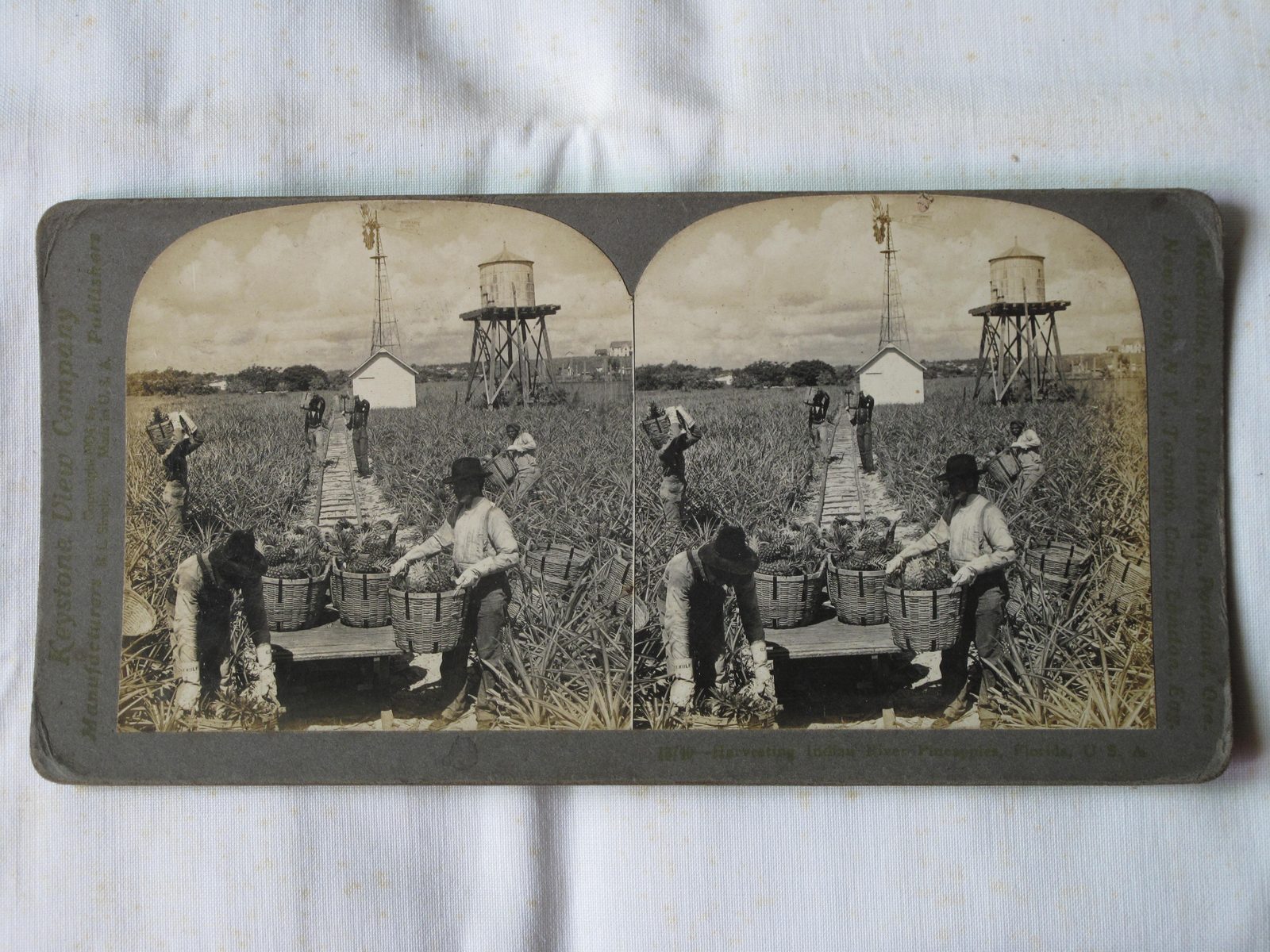
In June 1906 the St. Lucie County Tribune reported that Col. C. A. Van Duzee of Minnesota, president and general manager of the Minnesota Co-operative Plantation Company, had decided to make his home in St. Lucie County and would bring his family down the next winter. His company had extensive pineapple holdings at Viking, Florida, a settlement in the north end of the county, and he was busy that summer shipping the crop, with Fort Pierce as his headquarters. Viking was a small place, but between 1905 and 1911 the two Fort Pierce weeklies printed enough of its news to follow it: its growers and fishermen, its school, its votes, and its taxes.
A Minnesota company’s pineapples
The company was already planting in 1905. That September the Tribune’s Viking column reported the growers nearly done setting out their new pineapple fields: Hallstrom, Ericksen and Edwards had finished, and the Minnesota company would finish in a few days.
The papers described the plantation in large terms. In March 1907 the Tribune called it the largest pineapple plantation in the world. In October 1908 the Fort Pierce News, reporting the colonel home on Wednesday, October 14, from several weeks in St. Paul, called it one of the largest, and said the company could show a hundred acres of pines in a single field at Viking. Neither paper says how it measured.
The Viking column, 1905
The settlement’s own correspondent wrote in the Tribune under the heading VIKING, and in August 1905 began by calling the paper a welcome visitor in the little burg. The fishermen were getting ready for the fall fishing, and Nelson and Helseth had put a new engine in their boat. Mrs. John Helseth was home from a three-month visit to her mother in Norway. She had meant to bring her mother back with her, but her mother’s age and poor health would not allow the voyage.
By the end of September the column had other news. The school was to open on Monday, October 2, after a misunderstanding had kept it from opening on the 18th as the school board had ordered. Mrs. H. A. Wright and Miss Marian Wright were leaving that Friday for their old home in Glenwood, where Miss Marian would start school the next Monday, and their friends looked forward to their return the next year.
Pineapple land north of Viking too
The Tribune stood up for the north end. In August 1905 it answered an impression that the part of the county north of Viking was less suited to pineapples than the south. The high spruce and hickory land the crop depended on, it wrote, ran through the county from north to south, and no part was more fertile than the country north of Fort Pierce.
New growers came. In February 1906 C. T. McCarty sold twenty acres of pine land near Viking to a Mr. Peterson, a newcomer to the county who meant to improve it at once.
A growers’ association
In October 1909 the Fort Pierce News printed the notice of incorporation of the Viking Pineapple and Citrus Growers Association, organized under the state law for nonprofit horticultural associations. Like the charters printed from Ankona that same winter, it issued each member one certificate of membership for a dollar, allowed no one more than one, and admitted only growers of citrus fruit. The page on the pineapple plantations of the Indian River follows the growers’ organizations across the whole belt.
Ten votes to one for roads
Viking liked good roads. When the county voted on road bonds late in 1909, the Tribune of December 3 reported Viking once again the banner bond precinct, at ten votes to one. Jensen followed at forty-two to two, and Fort Pierce at one hundred and ten to thirteen.
Was Viking paying its share?
In April 1910 Viking’s prosperity became an argument in the Tribune’s letters. A correspondent wrote that the Viking section, through Mr. J. Helseth, had asked for recognition and offered proof of its progress. If so, the writer said, it was time for the tax assessor to value that end of the county properly, so that its people paid their share of the county’s taxes and the new bond issue. He argued that land in the north end was assessed at far less an acre than in the south, and that the assessor’s books showed no real increase there in two or three years.
A reply from Quay came the next week. Its writer had thought the Viking section was already treated fairly in the equalizing of taxes, and he did not accept that the Eden section, one of the richest pineapple sections in the county, was taxed out of proportion. Among his examples was Helseth’s own place: thirty acres of cultivated land, eleven of them in pines not yet bearing, assessed at $1,500 in 1909 and the same in 1910.
A new schoolhouse, 1911
In May 1911 the county school board recorded Viking’s school district election: J. J. Helseth and two neighbors were elected trustees, and the district voted a school tax of three mills. At the same meeting the board accepted a bid of $175 cash for the Viking school house and lot, and accepted Helseth’s offer to furnish an estimate, description and details for a new school house at Viking, to be presented at the June meeting.
Viking, Florida, in the county of 1905
Viking was one of the north-end settlements of the new St. Lucie County, and its people appear among the north-end visitors in the county seat. In the wet or dry election of 1906 it was one of the precincts that voted dry, a story told on the page on the wet or dry election of 1906. For the river settlements to the south, see Ankona and Eden.
Sources
This story is drawn from the two Fort Pierce weeklies of the day, The St. Lucie County Tribune and the Fort Pierce News, digitized by the Library of Congress in Chronicling America and in the public domain. Colonel Van Duzee and the Minnesota company are in the Tribune of June 8, 1906 (page 5) and March 1, 1907 (page 5), and in the News of October 16, 1908 (page 5).
The Viking column is in the Tribune of August 25, 1905 (page 3) and September 29, 1905 (page 3), the paper’s defense of the north end in the Tribune of August 4, 1905 (page 4), the north-end visitors in the Tribune of December 15, 1905 (page 5), and the land sale in the Tribune of February 9, 1906 (page 5). The growers’ association’s notice is in the News of October 15, 1909 (page 8). The road bond vote is in the Tribune of December 3, 1909 (page 1), the two letters in the Tribune of April 22, 1910 (page 1) and April 29, 1910 (page 3), and the school board’s minutes in the Tribune of May 19, 1911 (page 8).
The Tribune has no surviving issues for 1908 and the News none for 1907, so some years of Viking’s news survive in one paper only. Names on this page are given only where the scanned text reads them clearly.