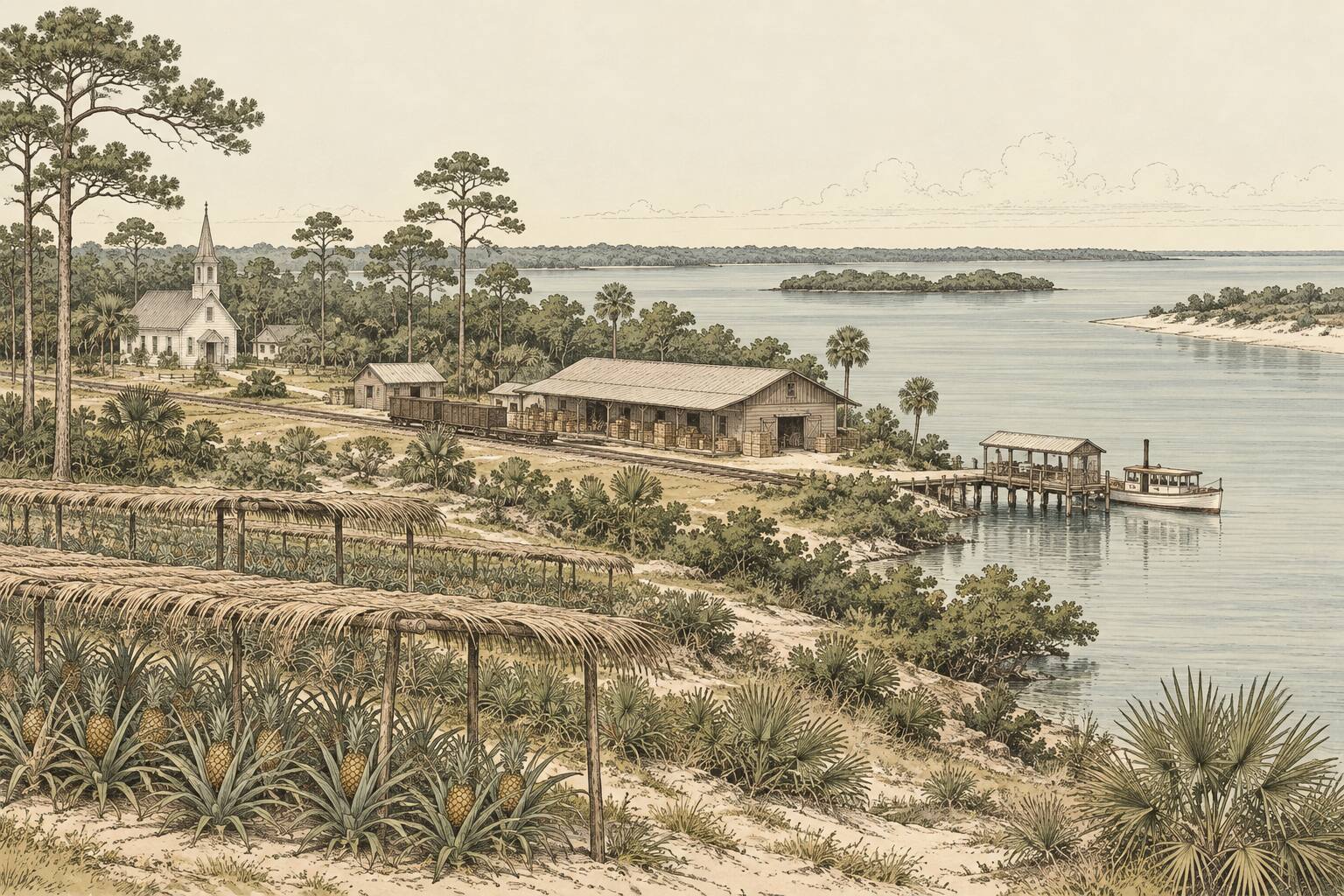
On a Friday morning in December 1905, the family went to call Rebecca J. Richards to breakfast at her son’s house in Stuart and found that she had died in the night. The next week The St. Lucie County Tribune put her death on its front page, under a headline that named her Eden’s pioneer citizen. The obituary beneath it is the nearest thing the record holds to a founding story for Eden, Florida, the small pineapple settlement on the Indian River where she had lived for twenty-four years.
How Eden, Florida got its name
Her husband, Thomas E. Richards, came to the Indian River two years ahead of her. By the obituary’s account he settled on the spot and named it Eden, because after the family’s old home in Connecticut it seemed to him a paradise. Rebecca followed him in the fall of 1881 and made her home at Eden from then on.
She was born in New York City, the obituary said, the daughter of Noah Brown, a shipbuilder it counted among the wealthiest men of his day and credited with building Commodore Perry’s fleet for the battle of Lake Erie in the War of 1812. Her husband died before her. In 1905 the Eden column of the Tribune still wrote of her as Mrs. Thomas E. Richards, and his estate still appears in county land lists printed in the Fort Pierce News in 1909 and 1911.
December 1905: up the river by launch
For a month before she died she had seemed in better health than usual. Old as she was, she made several trips with her daughter, Mrs. J. H. LeTourneau, to the towns nearby: to Fort Pierce about three weeks before, to Ankona, to Sewall’s Point and other places, and she seemed delighted to meet her friends wherever she went. In November she went to Stuart to visit her son and his family, and she was still enjoying good health on the day she died, the night of Thursday, December 7.
On Saturday morning her body was brought from Stuart to Eden by launch and carried by ten friends into the Eden Congregational church. One of her favorite hymns was sung as a solo at the service, the flowers were lavish, and a large gathering of friends went with her to the grave in the Eden cemetery. She left three children, Harry W. Richards of Stuart and Frank B. Richards and Mrs. LeTourneau of Eden, and twelve grandchildren.
The family that stayed
Her children’s households fill the Eden column for the next six years. In May 1906 Mrs. S. F. Webb gave a birthday dinner for Mrs. LeTourneau with fourteen at the table, and that week’s paper singled out two Eden pupils for playing their pieces through without a break at a music recital in the Jensen town hall. Mrs. LeTourneau and Mrs. F. B. Richards gave the children an Easter party on the Saturday before Easter in 1908, and the next spring the Easter egg hunt was at Mrs. Richards’s home on Easter Monday.
Packing houses by the station
Eden lived on pineapples. On Tuesday, November 20, 1906, about twenty-five growers from as far south as Dania met at Fort Pierce to talk over exporting the crop, at a meeting called by Walter Hawkins of the Consolidated Fruit Company. The News reporter counted four from Eden: F. G. McMullen, J. H. LeTourneau, C. A. Robinson and E. A. Ireland. Many of the growers’ wives came along and spent the day in town while the men met. A few weeks later the same paper called Robinson one of the pineapple kings of Eden.
In late March 1909 the Eden correspondent found the pineapple fields a beautiful sight that promised an early and abundant crop. The next week J. H. LeTourneau took delivery of a carload of lumber to build a packing house on his place near the station. A week later it was going up, so long that the column hoped no engineer would make a mistake and hitch onto it. Charles Edason had just painted his own packing house, and in April 1911 work began on a boat house for him.
Church and Sunday school
The settlement’s church was the Eden Congregational church, where Rebecca Richards’s funeral was held, and it shared a preacher with its neighbors. On a Sunday in March 1907 the Rev. George Waldron preached at Eden at eleven in the morning, at the Ankona church at three in the afternoon, and then in the Jensen town hall. In 1909 and 1910 both papers printed the Rev. George Marsh’s Sunday morning subjects at Eden, and in November 1909 the Masons were especially invited to his sermon there.
The church held its annual Christmas tree entertainment on Christmas Eve, 1906, with everybody welcome. Its Ladies’ Aid Society gave an exchange tea in the winter of 1908 and an annual entertainment in the fall of 1909. In April 1909 Mrs. Webb took over as superintendent of the Sunday school, with Mrs. Phillips as her assistant and Mrs. LeTourneau as secretary and treasurer.
Eden in the county of 1905
Eden was one of the river settlements of the new St. Lucie County, with Jensen, Walton and Ankona for neighbors. The same Eden column that reported the LeTourneau packing house admired Jensen’s new station that April, the depot rebuilt after the Jensen fire of 1908. The crop that built the packing houses has its own page, the pineapple plantations of the Indian River, and the railroad beside them is on the page on the Florida East Coast Railway. The county was divided afterward, and the page on how St. Lucie County formed and was divided tells how the towns of its southern end came to lie in another county.
Sources
This story is drawn from the two Fort Pierce weeklies of the day, The St. Lucie County Tribune and the Fort Pierce News, digitized by the Library of Congress in Chronicling America and in the public domain. The obituary of Rebecca J. Richards is on the front page of the Tribune of December 15, 1905, and she appears as Mrs. Thomas E. Richards in its Eden column of August 18, 1905. The T. E. Richards estate is in the land lists of the News of May 14, 1909 and May 19, 1911.
The birthday dinner and the recital are in the Tribune of May 11, 1906, the Easter party in the News of April 24, 1908, and the Easter egg hunt, the Sunday school officers and the long packing house in the Tribune of April 9, 1909. The growers’ meeting is in the News of November 23, 1906 (front page, and the wives on page 5), and the pineapple kings in the News of December 7, 1906. The fields and the carload of lumber are in the Tribune of March 26, 1909 and April 2, 1909, and the Edason boat house in the Tribune of April 21, 1911.
The church is in the Tribune of March 1, 1907 (the preaching round) and in the News of December 21, 1906 (the Christmas tree), February 21, 1908 (the exchange tea) and November 5, 1909 (the entertainment). The Masons’ invitation is in both papers on November 12, 1909, the Tribune and the News. The Tribune has no surviving issues for 1908 and the News none for 1907, so some years of the Eden column survive in one paper only.