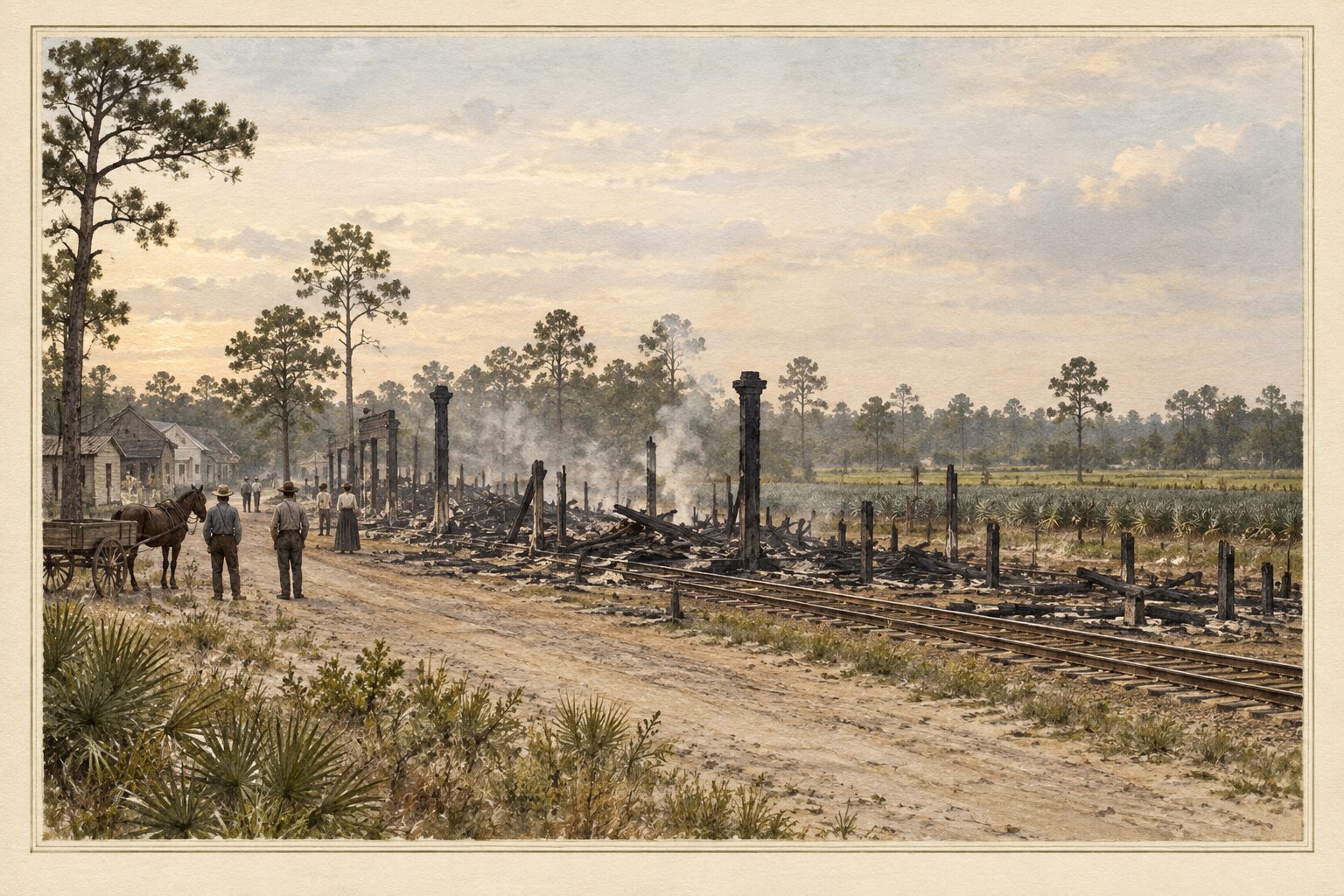
Between three and four o’clock on the morning of Sunday, May 3, 1908, the alarm went up at Jensen. Fire had broken out in the store of C. H. Munch & Co. on the town’s business street, and by the time it burned itself out the Jensen fire of 1908 had taken the whole business section: sixteen buildings, among them every store in town, the post office and the railway depot.
The loss ran to more than sixty thousand dollars, against less than fifteen thousand dollars of insurance. Jensen was a pineapple town on the Indian River and a station on the Florida East Coast Railway, and the year it spent rebuilding, the depot above all, is the rest of the story.
How the Jensen fire of 1908 spread
Everybody turned out, to fight the fire and to drag goods out of the buildings in its way. From Munch’s store it took the town hall next door and then a boat shop on the east. To the west it caught a little building that had once been the post office, the big store of the Jensen Trading Company, and a warehouse belonging to James Neal on the far side of the railroad track.
Across the street it burned the post office building, which also held a stock of marine hardware and, upstairs, the Masonic lodge. Then came a meat market, and James Neal’s big store, which filled two buildings and had his family living upstairs, and a bowling alley to the north. From there the fire leaped about sixty feet and took the passenger depot, some three hundred feet of platform, five empty boxcars on the sidetrack in front of the station and part of the track itself. A bakery that was also a home went next, and then one more building, before the fire ran out of things to burn.
The small houses nearby were saved only by the work of the Jensen people, though several were badly scorched and caught fire many times over; the one behind the town hall came through because many citizens worked hard to save it. The pineapple fields that ran up to the burned district took considerable damage.
No one knew how it began. The explanation most people accepted was a box of sawdust used as a spittoon in Munch’s store: something left burning in the evening had worked its way through the sawdust overnight and set the floor alight.
A town without a station
Two Sundays after the fire, the Congregational pastor held his service in the Jensen High School room and preached on lessons from fire, flood and cyclone. By July building was about to begin, and fine buildings were to take the place of the wooden ones the fire had taken.
The station was another matter. All that summer Jensen had no passenger or express depot at all. Railroad officials came and looked over the ground several times and let it be understood that a handsome station would be built, and then the matter was put off indefinitely. By August the people of Jensen had run out of patience, and the Fort Pierce News took their side: Jensen, it said, was one of the best paying stations on the line, and its people had a right to some consideration and convenience for their shipping. The complaint was headed for the state Railroad Commission.
The new depot, April 1909
In December the building material began to arrive, and by January the work was going quickly, with the town hoping a better train schedule would come with the new station. The railroad’s plans for the county seat waited on it: Fort Pierce was to get its own new depot once the one at Jensen was finished.
It was done in April. On a Monday that month the keys were handed to L. L. Yelvington, the Florida East Coast agent, who lost no time in moving in and claimed the distinction of the first business office in town to make the move. The old depot had burned to ashes. The new one was solid concrete under a genuine tile roof, built in the Spanish style, with rocked streets and sidewalks around it, and a correspondent in the Tribune thought it, by moonlight, as pretty a picture as anyone could wish to see.
That April the new Ricou block was fast nearing completion, and J. H. LeTourneau was building a large packing house at his place near the station.
Jensen in the county of 1905
Jensen was one of the pineapple towns of the Indian River, and the fields the fire scorched belong to the story told on the page on the pineapple plantations of the Indian River. The railroad whose depot burned and was rebuilt has its own page. Jensen lay in St. Lucie County in 1908; the county was divided afterward, and the page on how St. Lucie County formed and was divided tells how the towns of its southern end came to lie in another county.
Sources
This story is drawn from the two Fort Pierce weeklies of the day, The St. Lucie County Tribune and the Fort Pierce News, digitized by the Library of Congress in Chronicling America and in the public domain. The fire is in the News of May 8, 1908, the sermon in the News of May 15, the building plans in the News of July 17 and the depot complaint in the News of August 7, 1908.
The work on the station is in the News of December 4, 1908 and January 22, 1909, the Fort Pierce depot in the Tribune of February 26, 1909, and the new depot in the Tribune of April 9 and the News of April 16, 1909.