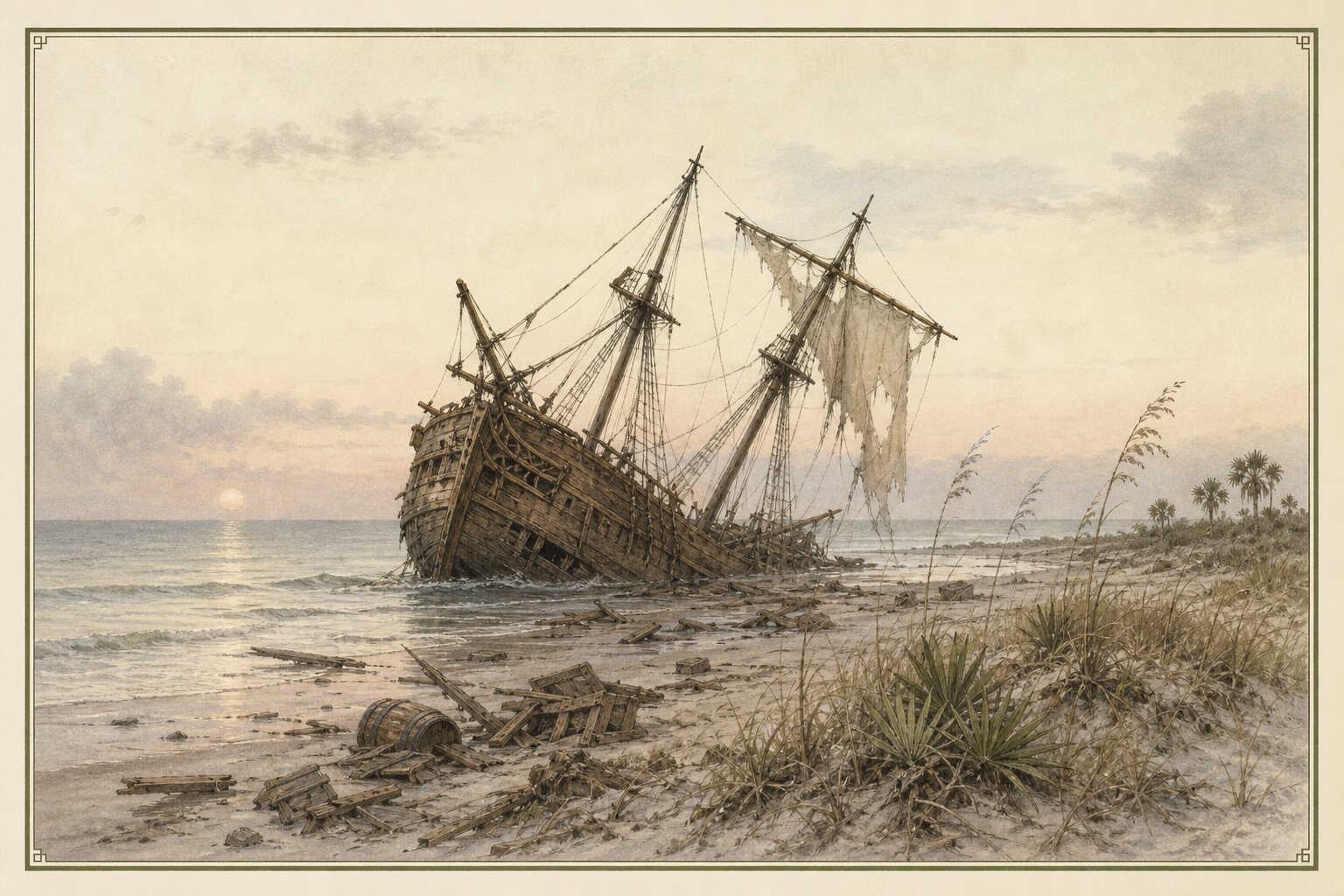
In the small hours of a late September night in 1696, a wooden merchant vessel called the Reformation was driven out of a storm and onto the sands of a Florida barrier island, a few miles north of the Jupiter Inlet. Everyone aboard survived the grounding. What awaited them on the beach, however, was a country no English colonist understood: the coast of the Ais people and their neighbors, a shore with no European settlement between the wreck and the Spanish garrison at St. Augustine, more than two hundred miles to the north.
The journey that followed carried Jonathan Dickinson, his family, and his companions on foot and by canoe along the length of what is now St. Lucie County. The journal he published three years later remains, to this day, the most detailed firsthand account ever written of the people who inhabited this coast.
A merchant voyage in a time of war
Jonathan Dickinson was a Quaker merchant of Port Royal, Jamaica, and in the summer of 1696 he was moving his household to Philadelphia, the young capital of Quaker Pennsylvania. England and France were at war, and merchant ships crossed the Caribbean in convoy for protection against French privateers. The Reformation sailed from Port Royal in late August carrying some two dozen souls: Dickinson, his wife Mary, their infant son Jonathan, the enslaved men and women of Dickinson’s household, the ship’s master Joseph Kirle and his crew, and an elderly and much-respected Quaker minister named Robert Barrow, returning from missionary travels in the Caribbean.
Somewhere along the passage the Reformation lost company with its convoy. Working alone up the Straits of Florida, the ship met worsening weather, and in the storm that followed it was driven ashore on the barrier island the maps now call Jupiter Island, near present-day Hobe Sound. The company came through the wreck alive, salvaged what provisions and goods they could from the broken hull, and found themselves castaways on an open beach at the far edge of the known world.
Definition: barkentine
A barkentine is a sailing vessel of three or more masts, square-rigged on the foremast and fore-and-aft rigged on the others. The rig required a smaller crew than a fully square-rigged ship, which made it a favorite of merchant traders in the seventeenth and eighteenth centuries. The Reformation, which carried Jonathan Dickinson and his companions from Jamaica in 1696, was a barkentine engaged in the ordinary commerce of the English Atlantic: sugar, provisions, and household goods moving between the Caribbean and the mainland colonies.
Aground in a country not their own
The survivors were discovered within hours by the people of the village at the Jupiter Inlet, the place whose name survives today in Hobe Sound. The encounter began with a question the castaways would hear again and again as they moved up the coast. The coastal people demanded to know whether the strangers were Nickaleer, the journal’s rendering of their word for the English. Spain claimed Florida, Spanish salvage parties and missionaries were a known quantity on this coast, and the English were something else: interlopers whose colonists and privateers were reshaping the Caribbean.
Fearing what an honest answer might bring, Dickinson’s party claimed to be Spaniards. The ruse was thin, and the journal admits it convinced almost no one, but it may have mattered. The castaways were stripped of most of their clothing and goods, the wreck was thoroughly plundered, and the company was held for a time in the village at the inlet. They were frightened, humiliated, and hungry. They were also, all of them, still alive.
What followed was a slow, desperate progress northward, the party begging and bartering its way from town to town along the lagoon coast with the permission and sometimes the escort of the people who ruled it. The territory they were crossing belonged to the Ais, whose country stretched along the Indian River Lagoon from around Cape Canaveral south to the St. Lucie Inlet. The whole of the modern St. Lucie County shoreline lay inside or immediately below it. The castaways walked the same barrier island beaches that county residents walk today, forded the inlets, and were carried across the wider waters in Ais canoes.
North through Ais country
One of the party’s first stops inside Ais territory was a town standing near the inlet the Spanish had called Santa Lucía since their short-lived fort of 1565, the name that would in time attach to the river, the inlet, and the county itself. Dickinson’s journal records the town under that Spanish name. For readers of St. Lucie history the passage is a small landmark: a name we now attach to a county of several hundred thousand people, appearing in an eyewitness account of 1696 as a living Indian town on the lagoon shore.
Farther north the party was brought to the principal town of the Ais, in the northern reaches of their territory, where the paramount chief held court. Here the castaways spent weeks in a strange captivity that was never quite slavery and never quite hospitality. The chief took charge of them, fed them after a fashion, and controlled their movements while messengers carried word of the wreck up the coast toward the Spanish.
Dickinson used the time to watch, and what he saw became the heart of his journal: the palm-thatched houses, the fish and palmetto berries and oysters that fed the towns, the ceremonies and drinking of the black tea called cassina, the authority of the cacique over the towns of the lagoon. He noted, with a merchant’s eye, that the chief kept a chest of Spanish treasure salvaged from earlier wrecks. The Ais had been gathering the cargoes of this dangerous coast for generations before the famous 1715 treasure fleet disaster scattered silver along these beaches and gave the Treasure Coast its name.
The journal also records moments of plain human kindness that cut against the terror of the party’s situation. Women of the towns took pity on Mary Dickinson and her baby, feeding and tending the infant when his parents had nothing to give him. That child, six months old when the Reformation struck, survived the entire ordeal.
The cold road to St. Augustine
Word of the castaways eventually reached St. Augustine, and the Spanish sent soldiers south to gather them up. The final leg of the journey, up the coast beyond Cape Canaveral in November, was the deadliest. The season’s first hard cold fronts caught a party that had been stripped of its clothing weeks before, and hunger had worn them down. Several of the company died of exposure and want on that last stretch of beach, among them enslaved members of Dickinson’s household whose names the journal sets down alongside the rest of the dead. It is a bitter feature of the story that the people who had the least choice about making the voyage paid its heaviest price.
The survivors reached St. Augustine in the middle of November 1696, nearly two months after the wreck. The Spanish, whatever the official hostilities between the crowns, received the ragged company with real charity: they were fed, clothed, and sheltered, and after they had recovered their strength the governor sent them north along the coast by canoe and open boat to the English at Charleston. From there they took ship for Philadelphia, arriving in the spring of 1697. Robert Barrow, the aged minister whose steadiness the journal credits through every extremity of the journey, survived to reach Philadelphia and died there within days of arrival.
God’s Protecting Providence
In 1699 Dickinson published his account of the ordeal in Philadelphia under a title in the full seventeenth-century style, beginning God’s Protecting Providence, Man’s Surest Help and Defence. The book was an immediate and lasting success, reprinted again and again for a century in Britain and on the Continent, and it has never really left print since. Readers took it up as a survival story and a testament of faith.
Historians and archaeologists came to prize it for something else: it is the fullest description that exists of the native peoples of Florida’s southeast coast, set down by an observant eyewitness who lived among them for two months at the very end of their independent history. The Library of Congress preserves early editions, and its record for the journal can be consulted online.
The journal must be read with its author’s limits in view. Dickinson was a seventeenth-century English colonist and slaveholder who feared and disdained the people on whom his survival depended, and his account interprets everything through that lens. Our article on the Ais people discusses how scholars read through Dickinson’s assumptions to recover the world he was describing. Within a few decades of his march up the lagoon, disease and slave raiding had destroyed the Ais as a people. The towns he walked through vanished; the journal remains. It is very close to the only voice we have from inside their country.
Dickinson himself prospered in Pennsylvania. He became one of Philadelphia’s leading merchants, served twice as the city’s mayor, and died in 1722. He is remembered today less for anything he did in that successful public life than for the two desperate months he spent on the Florida coast, and for the book they produced.
The wreck site and the county line
The place where the Reformation went ashore lies just south of today’s St. Lucie County, on Jupiter Island in what is now Martin County. Florida’s park service commemorates the story at Jonathan Dickinson State Park near Hobe Sound, a few miles from the presumed wreck site. But the story itself belongs to the whole Treasure Coast, and the longest and most consequential portion of the journey unfolded on the lagoon shore that St. Lucie County occupies today.
The castaways’ road ran through Ais country, past the town that carried the county’s future name, and along beaches where the 1715 fleet would later spill its silver. The wreck of the Reformation is where the written history of this stretch of coast, thin and fragmentary before 1696, suddenly comes into focus.
For the history of St. Lucie County, Dickinson’s journal is a founding document by accident. No one aboard the Reformation intended to write the county’s story. A storm put them on this coast, the Ais walked them up it, and a merchant’s discipline of daily record-keeping preserved what he saw. Two hundred and nine years later, when the Florida Legislature drew the boundaries of a new county and reached back to the old Spanish name of Santa Lucía, it was reaching for a thread that runs through Dickinson’s pages.