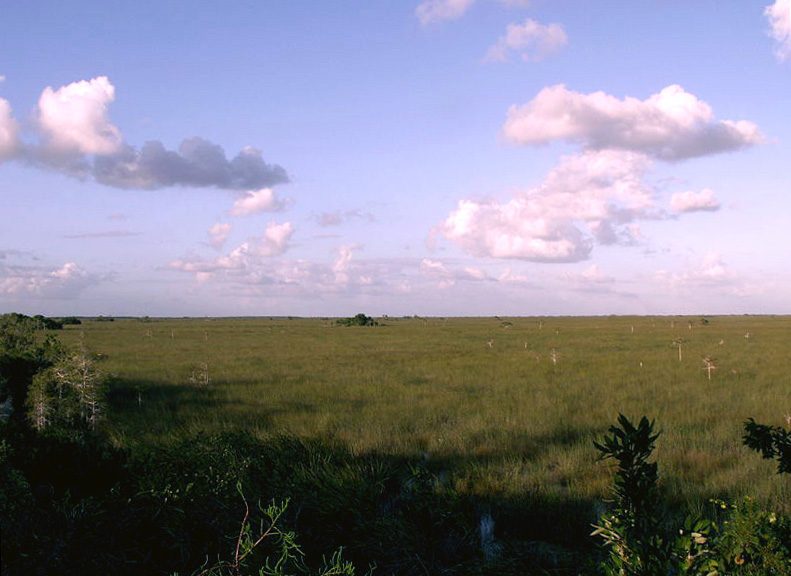
In a county where residential development has reshaped much of the landscape over the past half-century, Savannas Preserve State Park stands as an exception, a corridor of wild Florida that has survived largely intact amid the growth of the Treasure Coast. Located in St. Lucie County and extending southward into Martin County, Savannas Preserve State Park protects one of the last remaining freshwater marsh ecosystems on Florida’s east coast.
The park encompasses over 5,000 acres of basin marsh, wet prairie, pine flatwoods, and scrub habitat, preserving a landscape that was once common along the Atlantic coastal plain but has been largely eliminated by agriculture and urbanization over the past century. For the people of St. Lucie County, the Savannas represent something increasingly rare: a window into what the land looked like before roads, canals, and housing subdivisions transformed the region.
The name “Savannas” has been applied to this area for well over a century, used by early settlers to describe the broad, grassy marshlands that stretched between the Atlantic Coastal Ridge and the Indian River Lagoon. The word itself, derived from the Taino word zabana, meaning treeless plain, captures the essential character of the landscape: an open, wet grassland punctuated by scattered trees and shrubs, neither fully aquatic nor fully terrestrial but something in between. It is this in-between quality that makes the Savannas ecologically distinctive and that has sustained a community of plant and animal species found in few other places along the coast.
A rare landscape
Florida’s east coast was once lined with freshwater marshes like the Savannas. These wetland systems occupied the low-lying areas between the higher ground of the Atlantic Coastal Ridge, the ancient sand dune formation that runs parallel to the ocean, and the Indian River Lagoon to the east. Fed by rainfall and shallow groundwater, these marshes formed a chain of wet habitats stretching from the St. Johns River basin southward through Brevard, Indian River, St. Lucie, and Martin Counties.
They provided critical ecological services: filtering water before it reached the lagoon, storing floodwaters during the summer rainy season, and supporting a profusion of plant and animal life adapted to the rhythms of wet and dry seasons. For a deeper examination of these coastal systems and the geological forces that created them, see Florida Geology.
The twentieth century was not kind to these marshes. As Florida’s population boomed, particularly after World War II, drainage canals were dug to lower water tables, and vast stretches of wetland were filled or converted for agricultural and residential use. The city of Port St. Lucie, incorporated in 1961 as a planned community developed by the General Development Corporation, grew directly atop former marshland and flatwoods terrain.
By the late twentieth century, the marshes that had once defined the east coast landscape survived only in isolated fragments. The Savannas were the largest and most intact of these fragments in St. Lucie County, a long, narrow ribbon of wetland that persisted because it was too wet to build on easily and because its ecological significance had begun to attract conservation advocates.
The basin marsh ecosystem
Definition: basin marsh
A basin marsh is a type of freshwater wetland that forms in a shallow depression in the landscape, typically underlain by an impermeable layer of clay, marl, or hardpan that prevents water from draining away quickly. Basin marshes are characterized by fluctuating water levels, filling during the rainy season and partially or fully drying out during drought periods.
This cycle of flooding and drying creates a dynamic habitat that supports a distinctive community of grasses, sedges, and other herbaceous plants adapted to periodic inundation. Basin marshes are distinct from river floodplain marshes and from deeper-water systems such as lakes and ponds. In Florida, they were historically widespread in the coastal lowlands between the Atlantic Coastal Ridge and the Indian River Lagoon.
The Savannas are, in geological terms, a basin marsh system, a long, narrow freshwater wetland occupying a shallow depression that runs roughly parallel to the Atlantic coastline. The depression sits between the Atlantic Coastal Ridge to the east and the slightly higher ground of the interior flatwoods to the west. An underlying layer of relatively impermeable substrate prevents rapid drainage, causing rainwater to collect and persist in the basin rather than percolating down into the aquifer or flowing quickly to the coast.
The result is a landscape that is wet for much of the year, with water levels rising and falling in response to seasonal rainfall patterns. During the summer wet season, the marsh may be inundated to a depth of several feet; during the drier winter months, water levels recede, exposing mudflats and damp grasslands. To understand the broader ecological context of this system, visit Treasure Coast Ecosystems.
This seasonal fluctuation is how the system works. The alternation between wet and dry conditions creates a habitat mosaic that supports a wider range of species than either a permanently flooded marsh or a permanently dry upland could sustain on its own. Plants adapted to waterlogged soils grow alongside species that require periodic drying. Animals that depend on shallow water for feeding, wading birds, amphibians, and certain fish species, thrive during the wet season, while species adapted to drier conditions occupy the upland margins and the higher ground within the marsh during low-water periods. This dynamism is what gives the Savannas its biodiversity.
The Savannas marsh stretches approximately ten miles in a north–south orientation through St. Lucie County and into Martin County. It is rarely more than a mile wide, forming a slender corridor of wetland habitat sandwiched between developed areas on either side. This linear shape is a product of the underlying topography, the depression that holds the marsh is itself a product of the geological processes that shaped the Florida coastal plain over hundreds of thousands of years, as successive sea-level changes sculpted ridges and swales in the limestone and sand substrate.
Flora and fauna
Savannas Preserve State Park is biologically rich, particularly given its proximity to heavily developed areas. The park contains multiple distinct plant communities, each corresponding to subtle differences in elevation, soil type, and water regime. The wet marsh itself is dominated by grasses, sedges, and rushes, including maidencane, sawgrass, and various species of spikerush and beakrush.
Scattered throughout the marsh are patches of shrubby vegetation, including wax myrtle and dahoon holly, which colonize slightly higher ground. The margins of the marsh transition into wet flatwoods dominated by slash pine, with an understory of saw palmetto, gallberry, and wiregrass. Higher, drier ground within and adjacent to the park supports Florida scrub habitat, ancient sand ridges colonized by sand pine, scrub oak, and other species adapted to the nutrient-poor, fire-dependent scrub environment.
Among the park’s most notable residents is the Florida scrub-jay (Aphelocoma coerulescens), a species found nowhere else in the world outside of Florida. The scrub-jay is federally listed as threatened under the Endangered Species Act, and its survival depends on the maintenance of Florida scrub habitat, a plant community that is itself one of the most endangered ecosystems in the state.
Savannas Preserve supports a population of scrub-jays in the scrub habitats that border the marsh, making the park an important site for the species’ long-term survival. The U.S. Fish and Wildlife Service has designated critical habitat for the Florida scrub-jay, and the protected lands of the Savannas contribute to a network of scrub-jay conservation areas along the Treasure Coast.
The gopher tortoise (Gopherus polyphemus), another species of conservation concern, inhabits the upland scrub and flatwoods within the park. Gopher tortoises are considered a keystone species because the deep burrows they excavate provide shelter for hundreds of other animal species, including the endangered eastern indigo snake. Healthy gopher tortoise populations in the Savannas indicate the overall ecological integrity of the park’s upland habitats.
The freshwater marsh and its margins are critical habitat for wading birds, including great blue herons, great egrets, snowy egrets, little blue herons, tricolored herons, white ibis, and wood storks. The wood stork (Mycteria americana) is federally listed as threatened and depends on shallow wetlands for feeding. The seasonal drawdown of water concentrates fish and invertebrates in shrinking pools, creating ideal foraging conditions. During migration, the marsh serves as a stopover for sandpipers, plovers, and other shorebirds, and the National Audubon Society recognizes the Savannas as an important area for bird conservation.
The wetlands also support rare and regionally uncommon plant species. Several species of carnivorous plants, including sundews and bladderworts, grow in the nutrient-poor wet soils of the marsh, where the ability to capture insects for supplemental nutrients provides a competitive advantage. Their continued presence in the Savannas is a sign of the relative health of the ecosystem.
From wilderness to protected land
The conservation of the Savannas did not happen overnight. For decades, the marshlands of eastern St. Lucie County existed in a kind of limbo, too wet and low-lying for easy development, yet not formally protected from the drainage and filling that had consumed similar wetlands throughout the region. As the population of St. Lucie County grew rapidly in the 1970s and 1980s, development pressure on the Savannas intensified. Proposals to drain portions of the marsh for residential construction periodically surfaced, and the future of the wetland system was far from assured.
The movement to protect the Savannas gained momentum in the 1980s and 1990s, driven by a coalition of environmental organizations, concerned citizens, and government agencies that recognized the ecological significance of the marsh. Scientific studies documented the biodiversity of the Savannas and highlighted the rarity of the basin marsh ecosystem, providing the factual foundation for conservation arguments. The Savannas were identified as a priority acquisition site under Florida’s land conservation programs, including the Conservation and Recreation Lands (CARL) program and, later, the Florida Forever program, the state’s principal initiative for acquiring and protecting environmentally significant lands.
Through a series of land acquisitions spanning multiple years, the state of Florida assembled the acreage that would become Savannas Preserve State Park. The process was incremental, with individual parcels acquired from willing sellers using funds from the state’s conservation land-buying programs. In 2003, the Savannas Preserve State Park was officially designated, placing the marshlands under the management of the Florida Department of Environmental Protection, Division of Recreation and Parks. The park’s establishment was widely regarded as a major conservation achievement for St. Lucie County and the broader Treasure Coast region.
The park today encompasses over 5,000 acres, with additional parcels acquired through ongoing land protection efforts. Management involves active stewardship, including prescribed fire to maintain the fire-dependent scrub and flatwoods habitats that would otherwise be overtaken by woody vegetation. Invasive exotic species, Brazilian pepper, Australian pine, and melaleuca, pose ongoing threats and require sustained control. Hydrological management is also critical, as decades of drainage and canal construction in surrounding areas have altered the natural water flow patterns, and restoration efforts seek to return water levels closer to historical norms.
Visiting the Savannas
Savannas Preserve State Park is open to the public and offers a range of recreational and educational opportunities. Several miles of hiking trails wind through the preserve’s diverse habitats, from open marshlands to shaded pine flatwoods and sandy scrub ridges. Some routes follow elevated boardwalks that allow visitors to walk above the marsh without disturbing the wetland soils. An education center near the park entrance provides interpretive exhibits on the ecology and history of the Savannas.
Canoeing and kayaking are among the most popular activities. A paddling trail follows the waterways that thread through the marsh, providing intimate views of wading birds, turtles, alligators, and aquatic plant communities that are difficult to observe from upland trails. The park offers watercraft rentals, and fishing is permitted in designated areas. Bird watching is a particular draw, the combination of marsh, flatwoods, and scrub creates a diversity of birding environments within a compact area, and concentrations of wading birds feeding in the drying winter marsh can be spectacular. The park also hosts educational programs and guided walks led by rangers and volunteers, covering topics from native plant identification to the ecological role of fire in Florida’s landscape.
The Savannas and St. Lucie County’s future
The Savannas are more than a scenic amenity. The freshwater marsh provides ecological services that benefit the broader community in tangible ways, acting as a natural water filtration system that absorbs nutrients, sediments, and pollutants from stormwater runoff before they reach the Indian River Lagoon. Given the well-documented water-quality challenges facing the lagoon, including harmful algal blooms driven by nutrient pollution, the filtering function of intact wetlands like the Savannas is of practical as well as ecological importance.
The marsh also provides flood storage capacity, absorbing and slowly releasing large volumes of rainwater during the intense summer storms and hurricanes that characterize the region’s climate. In a low-lying, rapidly developing county, this natural flood control has measurable economic value. The Savannas absorb rainfall across thousands of acres of porous marsh soils and vegetation, moderating the impact of heavy rains on surrounding developed areas. For more on the weather patterns that shape these dynamics, see St. Lucie Weather.
The long-term health of Savannas Preserve depends on management decisions made not only within the park but in the surrounding landscape. Continued development, changes in regional hydrology, invasive species, and shifting precipitation patterns all pose challenges. The Florida Department of Environmental Protection, working with local governments and conservation organizations, continues to refine strategies for maintaining the ecological integrity of the Savannas.
For thousands of years before European settlement, these marshlands formed part of the ecological fabric that sustained the Ais people and other indigenous communities of the region. In a sense, Savannas Preserve State Park is a conservation project that reaches backward as well as forward, preserving a remnant of the landscape that existed for millennia while protecting ecological functions the county will rely on for generations to come. In St. Lucie County, where growth continues to transform the terrain, the Savannas stand as a reminder that some of the land’s most valuable functions are performed not by what has been built upon it but by what has been allowed to remain.
For more on the Indian River Lagoon and its relationship to St. Lucie County’s history and ecology, see our article on The Indian River Lagoon: St. Lucie County’s lifeline. For broader context on the region’s natural systems, visit Treasure Coast Ecosystems and Florida Geology.