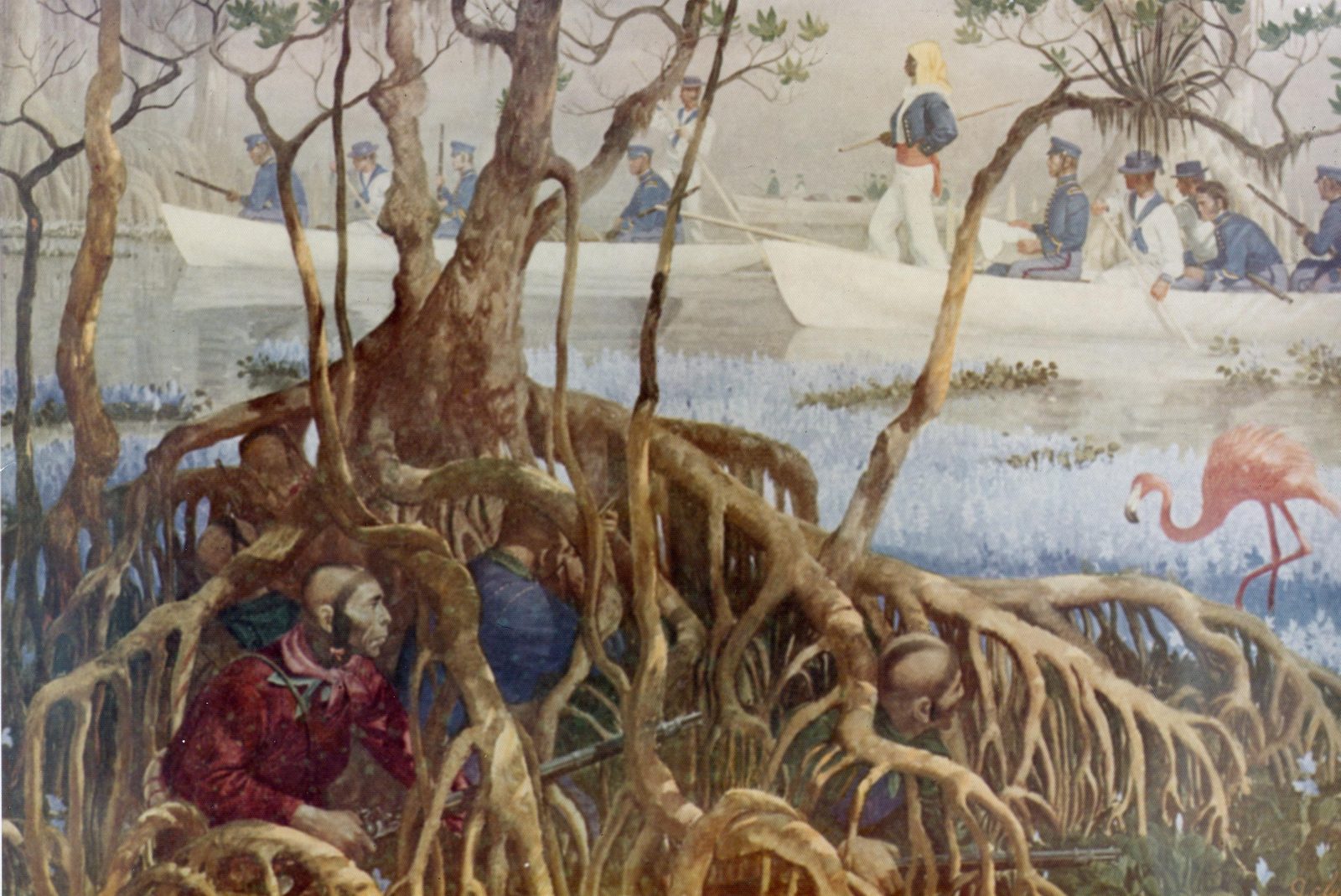
The Seminole Wars, three conflicts fought between the United States and the Seminole people of Florida from 1817 to 1858, rank among the most consequential chapters in the history of St. Lucie County. It was the Second Seminole War, the longest and most costly Indian war ever fought by the United States Army, that brought a permanent military presence to the Indian River coast and established the outpost that gave Fort Pierce its name.
The wars were fought over the federal government’s determination to remove the Seminole people to Indian Territory in present-day Oklahoma. That effort displaced thousands of Native people, claimed approximately 1,500 American soldiers’ lives, and laid the groundwork for the settlement of what would become St. Lucie County.
The wars also ended recently enough that the county born in 1905 could still feel them. In its first years, widows of the war’s soldiers were drawing pensions, the state was still settling its war claims, county roads followed trails named for the forts, and Seminole men came into Fort Pierce and posed for the town photographer. This page tells the story of the Seminole Wars, of the fort, and of that long afterward.
The road to war
The Seminole people were a confederation rather than a single ancient tribe. They descended mainly from Creek peoples of the Muscogee Confederacy who moved south into Spanish Florida during the eighteenth century, joined over time by other displaced Native groups and by escaped enslaved African Americans, known as Black Seminoles, who formed their own communities within the broader nation. Their name is believed to derive from the Spanish word cimarrón, meaning wild or runaway, and the Seminoles themselves embraced it.
Florida became a United States territory in 1821, after General Andrew Jackson’s incursions of the First Seminole War (1817–1818) helped push Spain to give the peninsula up. The Treaty of Moultrie Creek confined the Seminoles to a poorly provisioned reservation in central Florida in 1823, and the Indian Removal Act of 1830 made their relocation to Indian Territory a matter of national policy. When some leaders signed the removal Treaty of Payne’s Landing in 1832, much of the nation rejected it as coerced. Among the most vocal opponents was Osceola, not a hereditary chief but a war leader whose fierce opposition to removal rallied Seminoles across Florida.
The Second Seminole War (1835–1842)
The war erupted on December 28, 1835, with two strikes on a single day. Osceola and a group of warriors killed Wiley Thompson, the Indian agent charged with enforcing removal, outside Fort King near present-day Ocala, and a Seminole force ambushed a column of 108 soldiers under Major Francis L. Dade on the road from Fort Brooke to Fort King, leaving three survivors. What followed was a war unlike any the Army had fought before. The Seminoles waged a guerrilla campaign from Florida’s swamps, hammocks, and pine flatwoods, and a rotation of commanding generals, Winfield Scott, Thomas Jesup, and Zachary Taylor among them, could not force a decisive engagement for seven years.
Osceola was captured in October 1837 under a flag of truce, an act widely condemned even by Americans sympathetic to the government’s cause, and died at Fort Moultrie, South Carolina, in January 1838. The war went on without him under leaders including Coacoochee, known as Wild Cat, Halleck Tustenuggee, and Sam Jones, called Abiaki. Most of the Army’s dead were lost to malaria, dysentery, and the other diseases of the Florida interior rather than to Seminole weapons.
Fort Pierce: an outpost on the Indian River
As the war expanded across the peninsula, the Army established a chain of military outposts to project force into areas where the Seminoles operated. Along the Indian River coast, the long, narrow estuary that runs parallel to Florida’s Atlantic shore, the Army built a series of forts to control waterborne movement, supply inland operations, and deny the Seminoles access to the coast. The Indian River Lagoon served as a vital supply corridor, and the forts along its shores were essential links in the Army’s logistical network.
In January 1838, Army troops under the command of Lieutenant Colonel Benjamin Kendrick Pierce established a military post on the west bank of the Indian River in what is now St. Lucie County. The post was named Fort Pierce in honor of its commander.
Benjamin Kendrick Pierce was a career officer who had served in the War of 1812, and the older brother of Franklin Pierce, later the fourteenth President of the United States (1853–1857). The fort he established was one of many along the Indian River, but it would prove to be the one whose name endured, outlasting the military post itself to become the name of the permanent settlement, and eventually the city, that grew up on the same site.
The Indian Removal Act of 1830
The Indian Removal Act, signed into law by President Andrew Jackson on May 28, 1830, authorized the federal government to negotiate treaties with Native American nations in the eastern United States for their removal to lands west of the Mississippi River, in what was designated Indian Territory (present-day Oklahoma). While the act did not explicitly authorize the use of force, it provided the legal framework for the coerced and often violent relocation of tens of thousands of Native people, including the Cherokee, Chickasaw, Choctaw, Muscogee (Creek), and Seminole nations. The Seminoles’ resistance to removal under this act was the direct cause of the Second and Third Seminole Wars in Florida.
Fort Pierce was a typical frontier outpost of the era: a modest collection of wooden structures, barracks, a storehouse, officers’ quarters, surrounded by a defensive perimeter. The garrison patrolled the surrounding pine flatwoods and the Indian River, and its soldiers endured the hardships that afflicted the Army throughout the Florida war: oppressive heat, swarms of mosquitoes, inadequate supplies, and the constant threat of disease.
The fort was part of a network of posts that included Fort Capron to the north and Fort Jupiter to the south, connected by water routes along the lagoon and by rough overland trails. For more on the military history of the fort itself and the city that grew from it, see our sister publication, The Fort Pierce Annals.
The Seminole Wars end, the people remain
The Second Seminole War lasted from December 1835 to August 1842 and cost the federal government an estimated $30 million to $40 million, a staggering sum for the era. Thousands of Seminoles were captured or surrendered and were forcibly relocated to Indian Territory, a journey often made under military guard that claimed additional lives. The war ended not with a treaty but with a declaration: by 1842 the Army found it impractical to pursue the last bands into the Everglades and Big Cypress Swamp, and the government simply declared the war over.
The Ais people, the earlier inhabitants of this coast, had already disappeared as a distinct group generations before; now most of the Seminoles, too, had been driven from the land.
The uneasy peace lasted little more than a decade. In December 1855, an Army patrol destroyed the crops and property of a band led by Billy Bowlegs, called Holata Micco, in the Big Cypress, igniting the Third Seminole War (1855–1858), a smaller conflict of patrols and skirmishes in the southern peninsula. Billy Bowlegs and a group of his followers accepted removal in 1858.
Perhaps 200 to 300 Seminoles never surrendered and never signed a treaty, keeping their communities in the most remote wetlands of southern Florida. Their descendants are today’s Seminole Tribe of Florida, federally recognized in 1957, and the Miccosukee Tribe of Indians of Florida, recognized in 1962, peoples who can say with justification that the United States never conquered them.
A war still on the books, 1905 to 1911
St. Lucie County was created in 1905, sixty-three years after the Second Seminole War ended, and the wars were still near. In March 1907 readers could follow the case of Phoebe A. Sparkman of Fairfield, the widow of Henry Sparkman of the First Regiment Florida Mounted Militia, who had served in 1839 and 1840. She had drawn a widow’s pension of eight dollars a month since his death in 1884. In 1907 a special act of Congress raised it. Her sworn petition gave her age as 110 years, the oldest pensioner on the rolls.
The war was still on the state’s books as well. A million acres of the land granted to Florida had gone to pay the state’s claims from the Indian wars, and Washington refunded the sum only in the early 1900s. A state Indian War Claims Commission was still meeting in Tallahassee to receive claims in 1907, and in 1909 a bill was introduced in Congress to raise the pensions of Florida’s Indian-war veterans and their widows from eight dollars a month.
The wars survived on the map, too. County road plans of 1906 ran along the old Fort Drum road, and a road description of 1911 still measured from the old Fort Capron trail, named for the fort that had stood north of town. In Fort Pierce the fort’s ground stayed a known place: in 1906 a winter resident was planning a new house on the old fort property.
The return of Tom Tiger, 1907
The affair that showed most plainly how close it all remained began in January 1907, when a Pennsylvania man named J. T. Flournoy carried away the bones of Tom Tiger, a Seminole chief buried two miles inside the Everglades in a grave marked by the pipe he had smoked for many years. Flournoy told his companions he meant to place the skeleton in the Smithsonian Institution. He had hired a trader named Barber as his guide, and he brought the bones out to Fort Pierce in a box and shipped them north.
The response reached the Tribune’s front page that March under a headline reporting the Seminoles aroused and threatening. Word from the camps was that white men would be killed if the bones were not returned by the next moon, and the reports judged the Seminoles more stirred than at any time since the days of the Indian wars. The county commissioners acted at once, voting to send a representative to explain to the Seminoles, in person, the steps being taken to return the remains to their resting place, and to report back to the board.
The camps were county business: the St. Lucie County of 1905 ran west from the coast toward Lake Okeechobee, and the papers spoke of the Seminole Indians living in St. Lucie County.
Not every paper kept its head. By late April, papers elsewhere in Florida had the outraged braves on the warpath. The Tribune answered that the latest dispatches from Fort Drum and Tantie showed the Seminoles skinning alligators and tending corn ahead of the great tribal dance, noted that several Seminoles, unpainted, had been in Fort Pierce the week before, and judged the scare either a crude joke or the work of a writer seeing things at night.
In June the county’s own sheriff closed the story. Sheriff D. S. Carlton carried the recovered box out himself and was home again by Wednesday, June 12, 1907, having returned the bones to their original resting place. By his account the Seminoles were pleased that the white people had succeeded in returning the remains, accepted his word about the box’s contents without opening it, and declined to accompany him to the spot. Barber, who had guided Flournoy in, went along instead and identified the bones, the pipe, and the other relics as the ones carried away.
The legal ending was quieter. In July the state’s attorney was still undecided about prosecuting Flournoy, in part because the court papers had named the wrong initials, and Flournoy himself was by then in a northern state. Through the end of 1911, no prosecution had come.
Neighbors in the new county
While the Seminole Wars were passing into the pension rolls, the Seminoles themselves were a living presence in the young county. Seminole men still came up out of the Everglades into town. In April 1909, Billy Stewart and Johnny Doctor were in Fort Pierce, and Photographer Hill had Billy pose before his camera. That same month, word came out of the Everglades in a message sent by Billy Bowlegs that Tallahassee, a chieftain of the Florida Seminoles, had died. His band had hidden in the Everglades rather than submit when the last deportations were made, and the town read of him as a man who had never yielded.
The church was in the Everglades in those years as well. Dr. Irenaeus Trout, the Episcopal missionary to the Seminoles, returned from the mission in the fall of 1909 reporting encouragement in the work. On August 6 of that year he had baptized Efawlebarjo, whose name was rendered in English as Crazy Owl, and who was described as the most influential man among the Seminoles.
Removal was still in the air as late as 1909. That fall a report circulated that the last survivors of the tribe, under Chief Tiger Tail, would soon remove to Oklahoma. The Fort Pierce News answered by reprinting a New York writer’s argument that the Florida Seminoles would be foolish to go: the Oklahoma reservation lands were mostly bought up, and Tiger Tail’s people lived free in country almost no one else could travel, guiding tourists out of the swamp and robbing no one.
The same piece put numbers on the people who remained. The federal census of 1900 had counted 350 Indians in Florida; government agents estimated 575; Floridians reckoned about 400. When Osceola stirred the nation to war in 1835, it noted, the Seminoles had numbered about 3,000.
The state was draining the Everglades in those same years, and its fleet carried the wars’ names into the county. On a Monday afternoon in July 1909, three steel vessels built in Jacksonville for the state drainage board tied up at Cobb’s dock in Fort Pierce on their way south. They were named Billy Bowlegs, Tom Tiger, and Tallahassee.
A permanent home came slowly. In the summer of 1911, President Taft issued an order withdrawing tracts in the lower peninsula from entry and setting them aside as reservations for the Seminole Indians, the fruit of years of work by their friends, Bishop Gray of the Episcopal church among them. That fall the Tribune gave its readers a long account of Osceola and Billy Bowlegs and the wars, history now, though the pension rolls still carried women who remembered it all.
Legacy: from military outpost to county seat
The military forts established during the Seminole Wars served as the nuclei for permanent settlement in many parts of Florida, and St. Lucie County is one of them. Fort Pierce, the outpost established by Lt. Col. Benjamin Kendrick Pierce in January 1838, was abandoned by the Army after the Second Seminole War ended in 1842. But the site’s location on the Indian River, with fresh water, productive fishing grounds, and the sheltered waterway of the lagoon, made it attractive to the settlers who began filtering into the region in the decades that followed.
By the 1860s and 1870s, homesteaders had established themselves along the Indian River near the old fort site, and the name Fort Pierce persisted in local usage. When the Florida East Coast Railway reached the area in the 1890s, the settlement grew rapidly, and in 1905 the Florida Legislature created St. Lucie County with Fort Pierce as its seat.
By 1909 the fort itself had disappeared. A town profile that year observed that the city was young as a municipality but old in its history, that it stood on the very ground where the old fort of the Indian wars had been built and had given the place its name, and that one of the east coast’s most thriving towns had grown up on the site. For more on the settlement era that followed, see our Settlement section.
The Seminole Wars also left a more complicated legacy, one of displacement, suffering, and the systematic dispossession of Native peoples from their homeland. In St. Lucie County, the memory of the wars is inextricable from the memory of the land itself: every acre of the county was once home to peoples who were removed by force, and the community that exists today was built upon the foundations of that removal. Understanding the Seminole Wars is part of understanding how this place came to be.
The Record’s ground is the county; the fort and the city that grew from it have their own historians at the Fort Pierce Annals, the coast’s first peoples are the subject of our page on the Ais, and the county’s creation in 1905 is told on the page about the formation of St. Lucie County.
Sources
The 1905 to 1911 material on this page is drawn from the two Fort Pierce weeklies of the day, The St. Lucie County Tribune and the Fort Pierce News, digitized by the Library of Congress in Chronicling America and in the public domain. The taking of Tom Tiger’s remains and the commissioners’ action are in the Tribune of March 8, 1907, with Mrs. Sparkman’s pension on the next page; the warpath scare answered in the Tribune of April 26, the sheriff’s return trip in the issue of June 14, and the stalled prosecution in the issue of July 26, 1907.
The war-claims land is in the Tribune of March 30, 1906, the claims commission in the issue of September 27, 1907, and the pension bill in the issue of April 16, 1909; the old Fort Drum road in the Tribune of October 19, 1906, the old fort property in the issue of November 30, 1906, and the old Fort Capron trail in the issue of July 7, 1911.
Billy Stewart, Johnny Doctor, and the death of Tallahassee are in the Tribune of April 9, 1909; the baptism of Efawlebarjo in the Tribune of October 1, 1909; the answer to the removal report in the News of November 19, 1909; the drainage vessels in the News of July 9, 1909; the reservation order in the Tribune of July 21, 1911; the town profile in the News of February 26, 1909; and the Osceola and Billy Bowlegs feature in the Tribune of November 10, 1911.